

OCTOPUS
The Price of Freedom
The ancestors of octopuses once had protective shells. Over millions of years, their descendants lost these shells, gaining something extraordinary: freedom of movement.
Without a rigid shell or bones, an octopus can squeeze through incredibly narrow openings, explore tiny crevices and hide in places where most predators cannot follow.
Some octopuses can even crawl out of the water and move across land for short distances, as long as their bodies remain moist.
But this freedom came at a price. Without a protective shell, an octopus is soft-bodied and vulnerable to predators.
Evolution has equipped octopuses with a remarkable collection of survival strategies. They can change color and skin texture in an instant, release clouds of ink, escape through impossibly small openings and use their intelligence to outsmart potential enemies.
By losing their armor, octopuses became masters of escape, camouflage and deception.
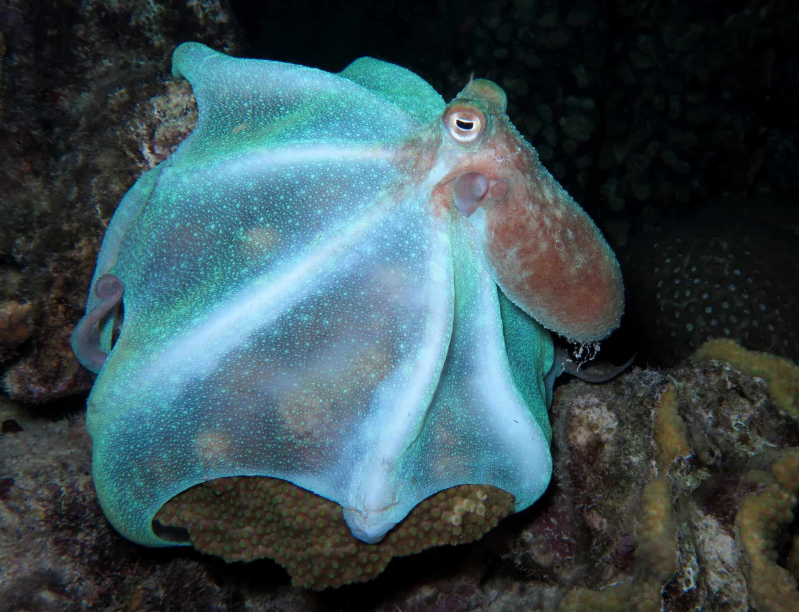
At a Glance
👀 How Common: Fairly common in the Caribbean, but rarely spotted because of its excellent camouflage and secretive behavior.
🔬 Scientific Name: Octopus briareus
🐙 Family: Octopodidae
📏 Size: Arm span up to approximately 1 m (3.3 ft).
🎨 Appearance: Eight long arms, large eyes and soft, flexible body. Can rapidly change color, pattern and skin texture to blend into its surroundings.
🌊 Habitat: Coral reefs, rocky areas, crevices and seagrass beds, usually in shallow coastal waters.
🦀 Diet: Mainly crabs, shrimp, mollusks and other small marine animals.
🌙 Activity: Mostly nocturnal, spending much of the day hidden in a den.
🧠 Intelligence: Highly intelligent, capable of learning, solving problems and remembering experiences.
🦎 Camouflage: Specialized skin cells allow almost instant changes in color and pattern. Muscles also change the texture of its skin.
💙 Three Hearts: Two hearts pump blood to the gills, while the third pumps it to the rest of the body.
🩸 Blue Blood: Contains copper-based hemocyanin instead of the iron-based hemoglobin found in human blood.
💨 Defense: Can release a cloud of ink to confuse predators and escape.
🥚 Reproduction: Females guard and care for their eggs until they hatch. They usually die shortly afterward.
🌴 ABC Islands: Found around Aruba, Bonaire and Curaçao.
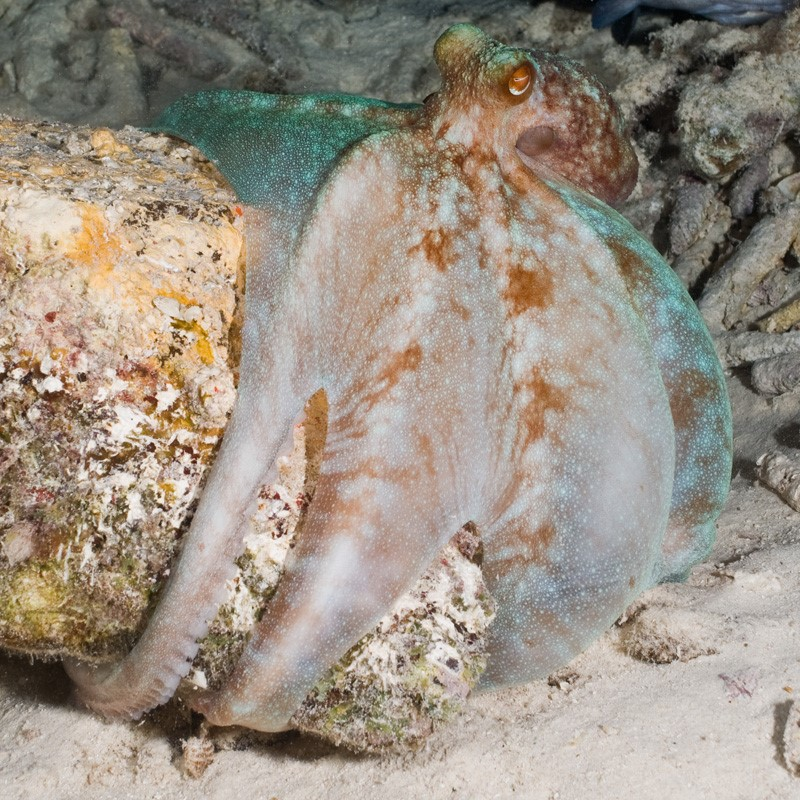
Photo: Alessandro Dona
What Makes Octopuses Special?
A Personality of Their Own
Perhaps one of the most fascinating things about octopuses is that they seem to have individual personalities. Some are curious and adventurous, while others are shy and cautious.
And when an octopus looks directly into your eyes, you sometimes get the remarkable feeling that it is just as curious about you as you are about it.
Eight Arms, Nine Brains?
An octopus has one central brain, but much of its nervous system is distributed throughout its eight arms. Each arm contains large networks of neurons that can process sensory information and control movements independently. This allows an octopus to explore several objects at once without consciously directing every movement.
They Can Taste With Their Arms
The hundreds of suckers on an octopus's arms do much more than grip objects. They contain special receptors that allow the animal to detect chemicals through touch. In other words, an octopus can actually taste what it touches!
Surprisingly Intelligent
Octopuses are among the most intelligent invertebrates. They can solve puzzles, open containers, learn through experience and remember solutions. They are also remarkably curious, often investigating unfamiliar objects with their arms.
Almost Impossible to Hold
An octopus has no bones and an incredibly flexible body. It can squeeze through any opening large enough for its hard beak to pass through. Even a relatively large octopus can disappear into a surprisingly small hole.
Three Hearts and Blue Blood
An octopus has three hearts. Two pump blood through the gills, while the third circulates oxygen-rich blood throughout the body. Its blood is blue because it contains hemocyanin, a copper-based protein that transports oxygen.
A Short but Extraordinary Life
Despite their remarkable intelligence, Caribbean Reef Octopuses usually live only about one to two years. They grow rapidly, reproduce once and then die. Their entire fascinating life takes place in a surprisingly short time.

A Devoted Mother
Female octopuses lay thousands of eggs and carefully guard them, keeping them clean and supplying fresh, oxygen-rich water. During this period, the mother usually stops eating. After the eggs hatch, she dies, having devoted the final part of her life to protecting her young.

A Cloud of Ink
When threatened, an octopus can release a dark cloud of ink that confuses predators and provides valuable seconds to escape. It can then use jet propulsion to shoot away through the water.
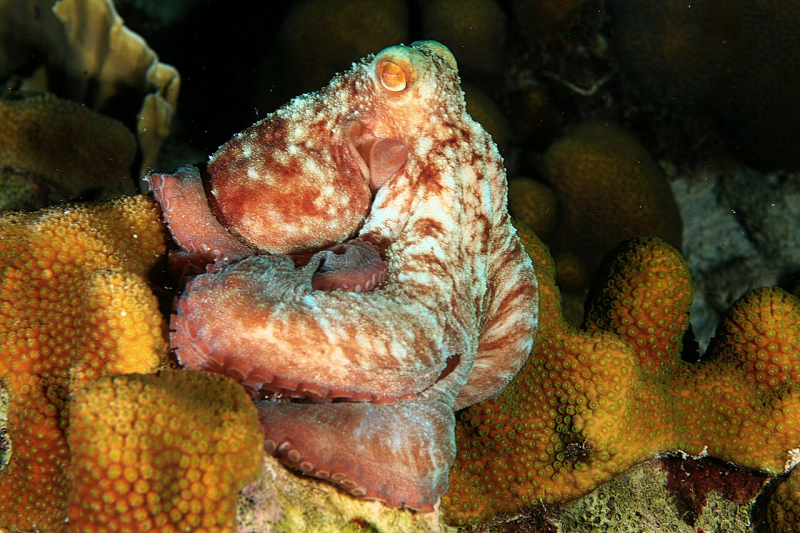
Disguise
An octopus can change its color, pattern and even the texture of its skin in less than a second. It can transform from smooth and pale to dark, spotted and covered in bumps, perfectly imitating rocks, coral or sand. Remarkably, octopuses are thought to have limited color vision, yet they are among the ocean's greatest camouflage artists.