

CARIBBEAN REEF SQUID
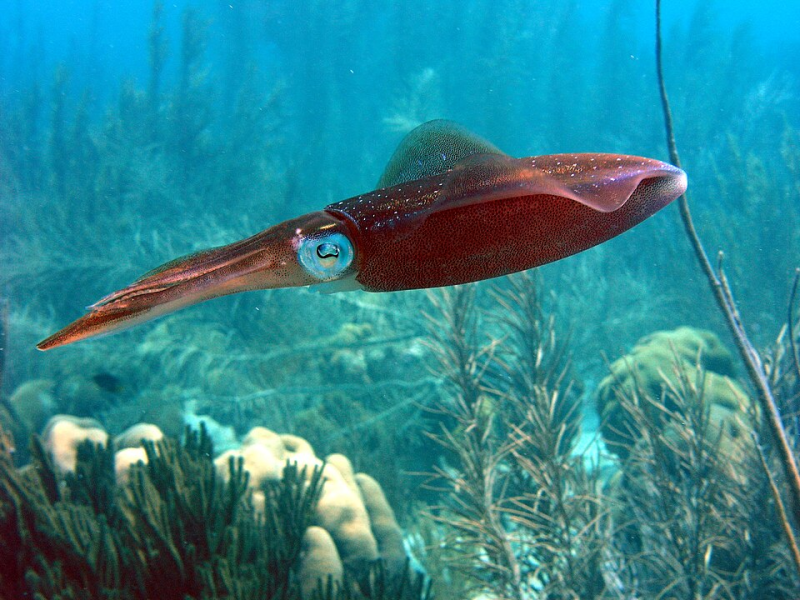
Photo by Jerred Seveyka
At a Glance
👀 How Common: Common in the Caribbean, especially in shallow coastal waters. Often seen in small groups.
🔬 Scientific Name: Sepioteuthis sepioidea
🦑 Family: Loliginidae
📏 Size: Usually 15–25 cm (6–10 in) mantle length, occasionally reaching about 30 cm (12 in).
🎨 Appearance: Elongated body with broad fins along the sides, large eyes and ten appendages: eight arms and two longer feeding tentacles. Can rapidly change color and pattern.
🌊 Habitat: Shallow coral reefs, seagrass beds, sandy areas and coastal waters.
🦐 Diet: Small fish, shrimp and other crustaceans.
☀️ Activity: Active during both day and night, often hunting more actively in low light.
👥 Social Behavior: Frequently swims in small groups, maintaining surprisingly coordinated formations.
🌈 Color Communication: Uses specialized skin cells called chromatophores to display rapidly changing colors and patterns.
💨 Movement: Swims using its fins and jet propulsion, allowing it to move forward, backward and sideways.
🛡️ Defense: Can release ink to confuse predators and escape.
🥚 Reproduction: Females attach clusters of elongated eggs to underwater structures. Unlike octopuses, they do not guard their eggs continuously.
🌴 ABC Islands: Found around Aruba, Bonaire and Curaçao.

What Makes Caribbean Reef Squid Special?
Masters of Hovering
Unlike octopuses, which often crawl along the seafloor, Caribbean Reef Squid spend much of their time swimming in open water.
Their broad fins allow them to hover almost motionless, move backward and make precise adjustments to their position. They can also use jet propulsion for a sudden burst of speed.
Ten Arms, Not Eight
Squid have eight arms and two additional, longer feeding tentacles. When hunting, they can shoot these tentacles forward to seize prey and pull it toward their sharp beak.
This makes them fast and effective hunters of small fish and crustaceans.
A Shell Hidden Inside
Unlike octopuses, which have lost their shells completely, squid still retain a reduced internal shell called a gladius, or pen.
This thin, flexible structure supports their streamlined bodies without restricting their movement.
It is a fascinating reminder that squid and octopuses evolved from ancestors with external shells.
Big Eyes and Sharp Vision
Squid have remarkably sophisticated eyes, well suited to detecting movement, shapes and contrasts underwater.
Although their color vision is thought to be limited, they can produce an astonishing variety of colorful signals. How they perceive and interpret these displays remains a fascinating subject of scientific research.

A Surprisingly Social Animal
Caribbean Reef Squid are often seen swimming together in small groups. They maintain their distance from one another, adjust their movements and communicate constantly through changing body patterns.
Watching a group of squid hovering together can feel almost like observing a carefully choreographed underwater dance.

Talking With Colors
Caribbean Reef Squid communicate through remarkable displays of color and pattern. Using thousands of tiny pigment-filled cells called chromatophores, they can change their appearance almost instantly.
Different patterns can signal aggression, attraction, alarm or submission. It is almost as if they have developed their own visual language.
Two Messages at Once
Perhaps their most extraordinary trick is the ability to display different patterns on opposite sides of their bodies.
A male squid courting a female may show her a courtship pattern on one side while displaying a warning pattern toward a rival male on the other.
Imagine having two completely different conversations at the same time, without saying a word!

A Short but Spectacular Life
Despite their complex behavior, Caribbean Reef Squid typically live for only about a year.
They grow quickly, reproduce and die shortly afterward. Their brief lives are filled with hunting, communication, competition and courtship.