

DOLPHINS

What Makes them so Special?
A close encounter with dolphins is something you never forget. Seeing an entire family together, adults and youngsters swimming side by side, playing and interacting with one another, is a truly special experience. There is something deeply fascinating about watching such intelligent and social animals in their natural environment. No matter how often you see dolphins, it remains a beautiful and unforgettable sight.
They Never Completely Fall Asleep
A dolphin cannot simply fall into a deep sleep and forget about breathing. Breathing is a conscious action, so dolphins sleep with one half of their brain at a time. The other half remains alert enough to control breathing, watch for danger and keep swimming when necessary. Even one eye remains open, connected to the active half of the brain.
Seeing With Sound
Dolphins can explore their surroundings using echolocation. They produce rapid clicking sounds and listen to the echoes that bounce back from objects, fish and other animals.
From these echoes they can determine remarkably detailed information about an object, including its distance, size and shape. This allows dolphins to hunt effectively even in dark or murky water.
Every Dolphin Has Its Own Whistle
Many dolphins develop a distinctive signature whistle when they are young. This whistle identifies the individual and functions somewhat like a name.
Other dolphins can copy another individual's signature whistle, apparently to address or contact that particular dolphin. They may even remember familiar whistles for many years.
Life in a Dolphin Society
Dolphins live in complex social communities. They form friendships and alliances, cooperate while hunting, play together and care for their young for years.
Their groups are not always fixed. Individuals may join and leave different groups, while maintaining long term relationships with particular dolphins.
Built for Speed
A dolphin's smooth, streamlined body creates very little resistance in the water. The powerful tail flukes provide propulsion, while the pectoral fins are used mainly for steering.
And unlike fish, which generally move their tails from side to side, dolphins propel themselves by moving their tail up and down, a reminder of their very different evolutionary history.
Intelligent, But Still Wild
Their curiosity, playfulness and apparent friendliness make dolphins especially appealing to humans. But they remain powerful wild predators with complex natural behavior.
The best encounters are therefore those in which dolphins are allowed to decide whether they want to approach, while we simply enjoy the privilege of sharing their ocean for a little while


Mothers and Calves
Dolphins are among the most intelligent and social animals in the ocean. They are mammals, just like us, which means they breathe air, are warm blooded, give birth to live young and nurse their calves with milk. Their ancestors once lived on land, but over millions of years they evolved into the streamlined swimmers we know today.
A dolphin calf is born tail first in most cases, an adaptation that reduces the risk of drowning during birth. Shortly afterwards, the newborn must reach the surface for its first breath.
Calves drink extremely rich milk from their mothers and remain dependent on them for a long time. During these years they do much more than grow, they learn how to hunt, communicate and behave as members of dolphin society.
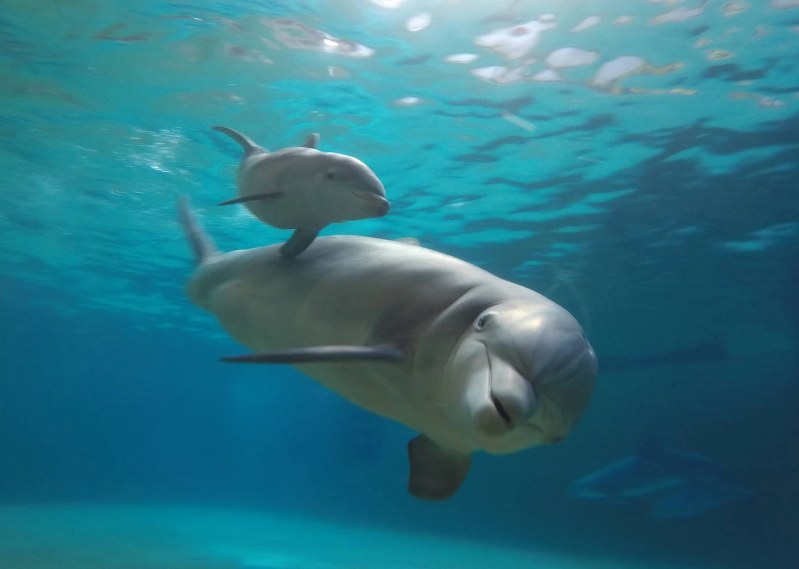
Bottlenose Dolphin
At a Glance
👀 How common: Regularly seen in Caribbean waters, although sightings around the ABC islands are unpredictable
🔬 Scientific name: Tursiops truncatus
📏 Size: Usually about 2–4 m (6.5–13 ft) long
⚖️ Weight: Around 150–650 kg (330–1,430 lb), with males generally larger than females
🎨 Appearance: Robust, streamlined body, usually dark gray on the back and lighter gray underneath, with a short, clearly defined beak
🌊 Habitat: Coastal waters, bays, reefs and deeper offshore waters
🐟 Diet: Mainly fish and squid, but also crustaceans
👥 Social life: Usually lives in flexible groups called pods, whose members may join or leave over time
💨 Breathing: Must surface regularly to breathe through a single blowhole on top of the head
📡 Echolocation: Produces clicks and listens to the returning echoes to locate prey and explore its surroundings
💬 Communication: Uses whistles, clicks and body movements to communicate. Individuals develop distinctive signature whistles
😴 Sleep: Sleeps with only one half of the brain at a time, allowing the other half to remain alert enough to surface and breathe
⏳ Lifespan: Often 40–50 years, with some females living considerably longer
🏝️ Curaçao, Bonaire & Aruba: Occurs in the waters around all three ABC islands, both close to shore and farther offshore

What Makes them Special?
A Remarkably Intelligent Hunter
Bottlenose Dolphins are famous for their intelligence and adaptability. Different populations have developed their own hunting techniques, and some even use tools. In certain areas, dolphins have been observed carrying marine sponges over their snouts while searching for prey on the seafloor, probably protecting themselves from sharp rocks and stinging animals.
They also recognize individuals and develop their own signature whistle, almost like a personal name.
Atlantic Spotted Dolphin
At a Glance
👀 How common: Regularly found in tropical and warm Atlantic waters, including the Caribbean, but sightings around the ABC islands are unpredictable
🔬 Scientific name: Stenella frontalis
📏 Size: Usually about 1.7–2.3 m (5.5–7.5 ft) long
⚖️ Weight: Usually around 90–140 kg (200–310 lb)
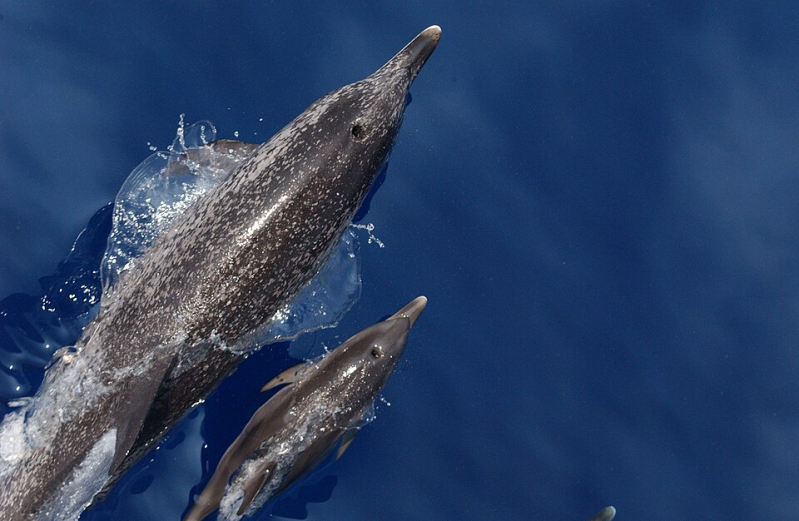
🎨 Appearance: Streamlined body with a dark back, lighter sides and pale belly. Adults develop distinctive light and dark spots
🐬 Young dolphins: Calves are born without spots and may initially resemble small Bottlenose Dolphins. Their spots gradually appear as they mature
🌊 Habitat: Warm coastal and offshore waters, often around continental shelves, islands and deeper reef areas
🐟 Diet: Mainly small fish and squid, with some bottom dwelling prey depending on habitat
👥 Social life: Highly social and usually travels in groups, sometimes forming much larger gatherings
🌊 Behavior: Energetic swimmers that may leap from the water, surf waves and ride the bow waves of boats
📡 Echolocation: Uses clicks to navigate and locate prey, even when visibility is poor
💬 Communication: Communicates with whistles, clicks and other sounds, as well as body movements
⏳ Lifespan: Thought to live for several decades, potentially around 40–50 years
🏝️ Curaçao, Bonaire & Aruba: Can occur in waters around the ABC islands, although encounters are much less predictable than in some other parts of the Caribbean
What Makes them Special?
Their Spots Reveal Their Age
Atlantic Spotted Dolphins are not born spotted. Calves are relatively plain, and the characteristic spots gradually appear as they grow older. Mature adults can become heavily spotted, so their appearance gives you a rough indication of their age.
They are also highly social and curious dolphins, often interacting with one another through touching, chasing and playful behavior.
Spinner Dolphin
At a Glance
👀 How common: Found throughout tropical and subtropical oceans, including the Caribbean. Sightings around the ABC islands are possible but unpredictable
🔬 Scientific name: Stenella longirostris
📏 Size: Usually about 1.3–2.1 m (4.3–6.9 ft) long, making it smaller and more slender than the Bottlenose Dolphin
⚖️ Weight: Usually around 45–75 kg (100–165 lb)
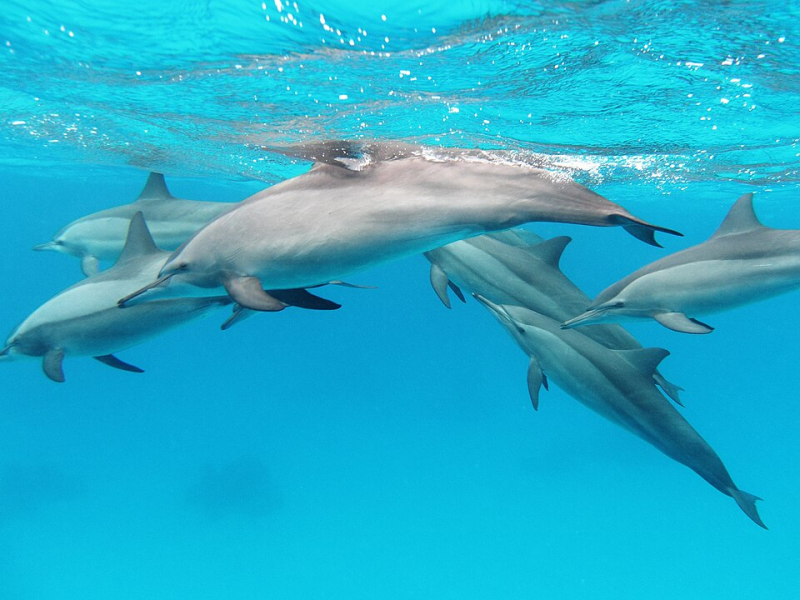
🎨 Appearance: Slender body with a long, narrow beak. Often shows a three tone pattern, with a dark gray back, lighter sides and pale belly
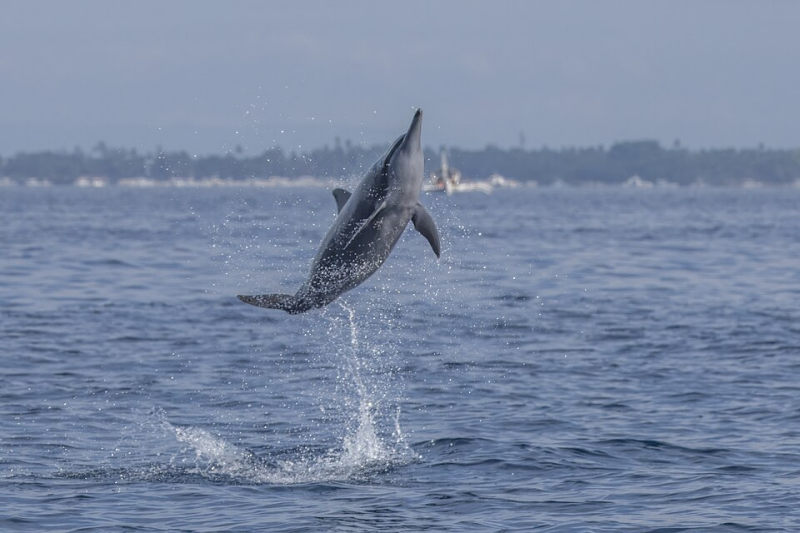
🐬 Special feature: Famous for spectacular leaps in which it can spin several times around its body axis before landing back in the water
🌊 Habitat: Mainly tropical offshore waters, although groups may come closer to islands and sheltered coastal areas to rest
🐟 Diet: Mainly small fish, squid and shrimp, often feeding at night
🌙 Activity: Frequently hunts at night in deeper water and rests or socializes during the day
👥 Social life: Extremely social and may travel in large groups containing dozens or even hundreds of dolphins
📡 Echolocation: Uses rapid series of clicks to navigate and locate prey in dark or deep water
💬 Communication: Uses whistles, clicks and body movements, with jumping and splashing also playing a role in social behavior
⏳ Lifespan: Around 20–30 years, although some may live longer
🏝️ Curaçao, Bonaire & Aruba: May be encountered in deeper waters around the ABC islands, particularly offshore
What Makes them Special?
The Acrobat of the Dolphin World
Spinner Dolphins are famous for launching themselves out of the water and rotating rapidly around their body axis, sometimes completing several spins during a single jump.
Exactly why they spin is still debated. The spectacular leaps may serve several purposes, including communication, play and possibly removing parasites or remoras from the body.
Their daily rhythm is also unusual. They often hunt offshore at night for fish, squid and shrimp that rise from deeper water, then spend much of the daytime resting and socializing.