

FLYING FISH

Flying Fish at a Glance
👀 How common: Common in tropical Caribbean waters, but usually seen offshore rather than close to the reef
🔬 Family: Exocoetidae
📏 Size: Most species are about 15–30 cm (6–12 in) long, although some can grow considerably larger
🎨 Appearance: Slender, streamlined body with exceptionally large pectoral fins that resemble wings
🌊 Habitat: Open ocean and offshore surface waters
🍴 Diet: Mainly plankton and other tiny organisms near the surface
🪽 Special feature: Their enlarged fins allow them to glide above the surface of the sea
💨 Takeoff: They accelerate underwater, break through the surface at high speed and spread their large fins once airborne
🐟 Extra boost: Before becoming fully airborne, they can rapidly beat the lower part of their tail against the water to gain additional speed
📐 Gliding: A single glide can cover tens of metres, and by repeatedly touching the water with the tail for another boost they can travel much farther
🦅 Why they fly: Gliding is mainly an escape strategy used to avoid predators such as tuna, mahi mahi and other fast open ocean hunters
⚠️ Danger above water: Escaping into the air does not make them completely safe, seabirds may be waiting for them there
🥚 Reproduction: Many species attach their eggs to floating material, seaweed or other objects near the surface
🏝️ Curaçao, Bonaire & Aruba: Flying fish can be seen in offshore waters around all three islands, particularly from boats.
- Fourwing Flyingfish, Hirundichthys affinis
- Atlantic Flying Fish, Cheilopogon melanuru
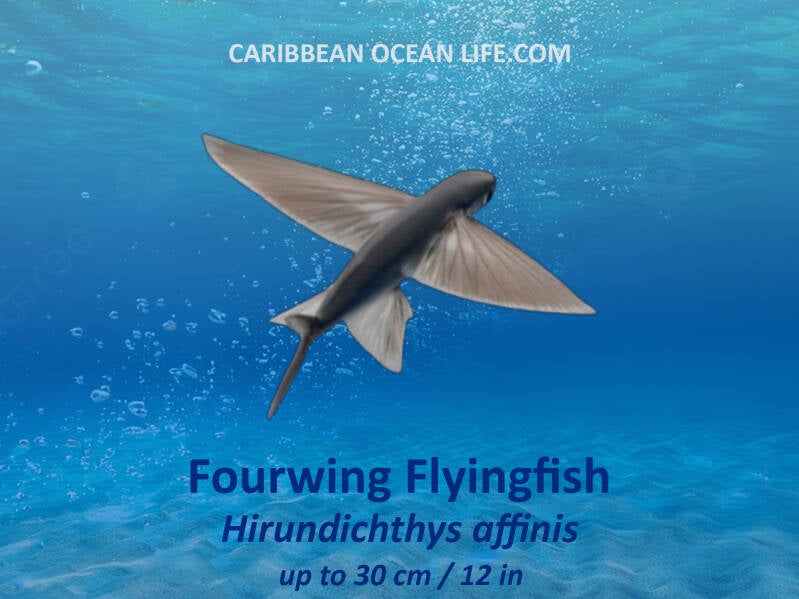
What Makes Flying Fish Special?
They Do Not Really Fly
Despite their name, Flying Fish do not flap their fins like birds. Instead, they glide through the air. Their enormous pectoral fins act like wings, generating lift once the fish has gained enough speed.
A High Speed Takeoff
Before leaving the water, a Flying Fish accelerates rapidly just beneath the surface. As its body emerges, the lower part of the tail may remain in the water and beat rapidly from side to side, providing an extra burst of speed before takeoff.
They Can Glide Surprisingly Far
A Flying Fish can travel tens of metres in a single glide. By dropping its tail back into the water and accelerating again without fully submerging, it can make several consecutive glides and cover much greater distances.
Some Have Four “Wings”
Flying Fish come in different designs. In some species only the pectoral fins are greatly enlarged, while in others both the pectoral and pelvic fins are enlarged. These are sometimes called four winged flying fish.
Flying Is an Escape Strategy
Their extraordinary ability evolved mainly to escape fast predators such as tuna, mahi mahi and other large open ocean fish. When chased from below, leaving the water can suddenly put considerable distance between predator and prey.
But the Sky Has Predators Too
Unfortunately, escaping the ocean does not necessarily mean escaping danger. Seabirds can catch Flying Fish while they are gliding above the surface. They essentially escape one hunting ground by briefly entering another.
Built for Two Worlds
Everything about a Flying Fish is designed for this remarkable escape technique: a streamlined body for speed underwater, an asymmetrical tail for acceleration at the surface and huge fins for gliding through the air.
For a fish, it is about as close to flying as you can get.