

CRABS
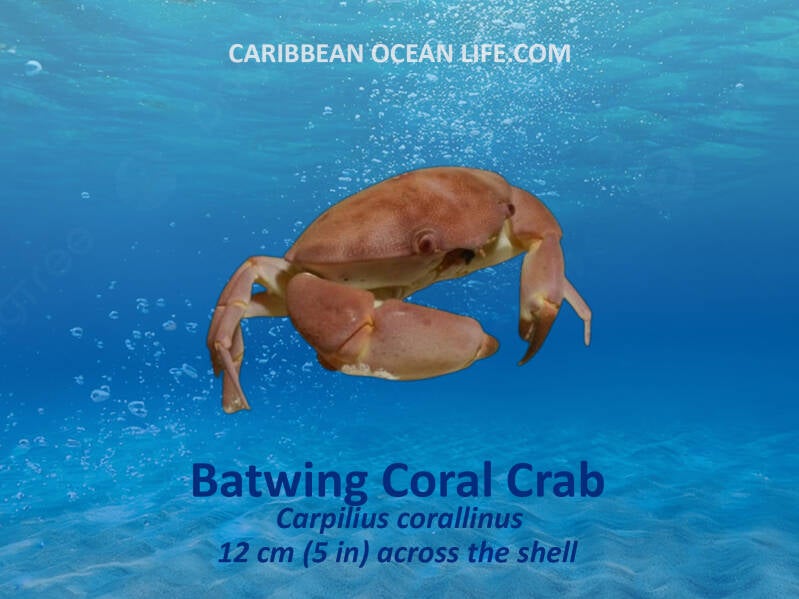
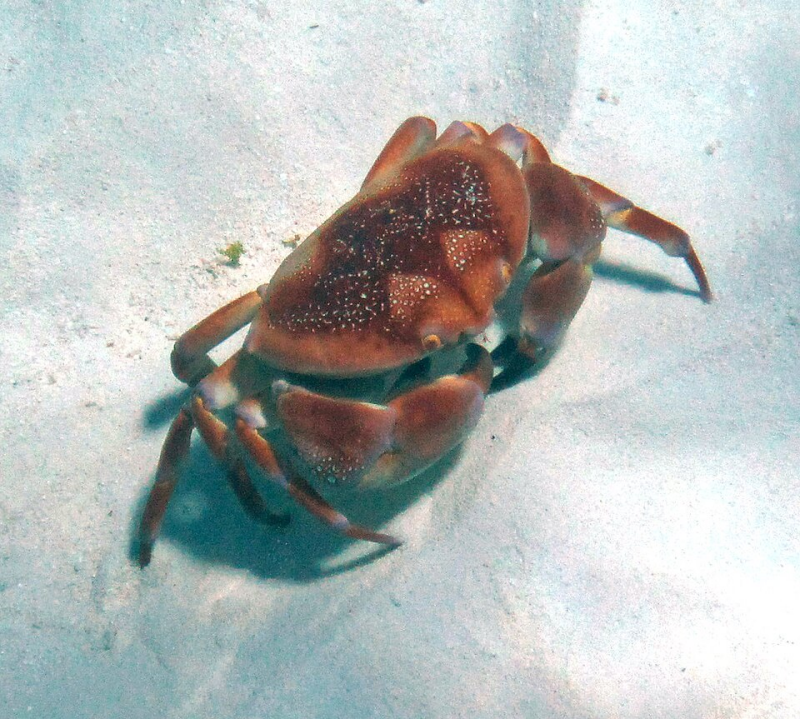
Batwing Coral Crab

Photo: deborachen
Batwing Coral Crab, At a Glance
👀 How common: Fairly common, but rarely seen during the day because it hides in reef crevices
🔬 Scientific name: Carpilius corallinus
📏 Size: Carapace up to about 15 cm (6 in) wide
🎨 Appearance: Cream to yellowish shell with distinctive red or reddish brown markings resembling spread bat wings
🪸 Habitat: Coral reefs, rocky areas and reef crevices
🍴 Diet: Carnivorous, feeding mainly on mollusks, sea urchins and other small reef animals
🌙 Activity: Mainly nocturnal, hiding during the day and emerging after dark to feed
💪 Powerful claws: Has extremely strong claws adapted for crushing hard shelled prey
🦀 Unequal claws: One claw is usually larger and more powerful, while the smaller claw is useful for handling food
🛡️ Protection: Its thick, smooth carapace and compact body provide excellent protection
♻️ Ecological role: Acts as a reef predator, helping influence populations of mollusks and other invertebrates
🏝️ Curaçao, Bonaire & Aruba: Found on coral and rocky reefs around the ABC islands
What Makes the Batwing Coral Crab Special?
A striking shell pattern
The Batwing Coral Crab is easy to recognize by the bold red or reddish brown markings on its pale shell. The pattern resembles the spread wings of a bat, which explains its common name.
Powerful claws
Its large, strong claws are designed for crushing hard prey. They allow the crab to break open the shells of snails and other mollusks, and to tackle animals such as sea urchins.
A secretive night hunter
During the day it usually stays hidden deep inside reef crevices. After dark it becomes active and ventures out onto the reef to search for food. This is why divers are much more likely to encounter one during a night dive.
One of the larger Caribbean reef crabs
With a carapace reaching around 15 cm / 6 in across, it is an impressively chunky crab. Add those hefty claws and it can look considerably larger.
Built like a little tank
Its thick, smooth carapace and powerful claws provide excellent protection. An adult Batwing Coral Crab is a pretty formidable little reef resident, definitely not a crab you would want attached to your finger.
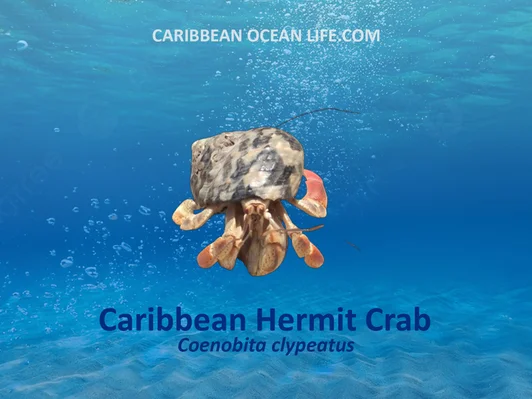
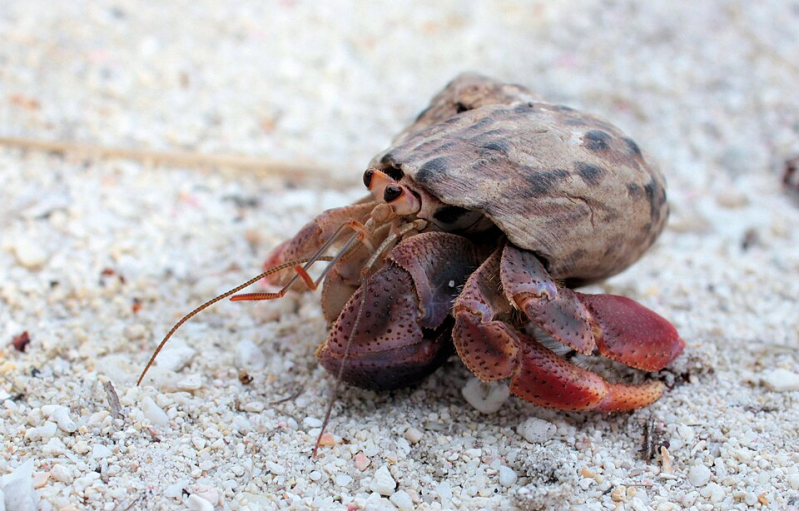
Caribbean Hermit Crab
Hermit crabs are among the most charming little characters of the Caribbean coast. Unlike true crabs, they have a soft, vulnerable abdomen, which they protect by moving into an empty snail shell. As they grow, they need to find a larger shell, making the search for the perfect home an important part of their lives.
Around Curaçao, Bonaire and Aruba, hermit crabs can be found both in the sea and on land. The tiny Blue Legged Hermit Crab lives in shallow coastal waters, while the much larger Caribbean Hermit Crab spends most of its life on land, wandering along beaches, rocky shores and through coastal vegetation.
Despite their very different lifestyles, they share the same unusual solution to staying safe: they carry their home wherever they go.

Caribbean Hermit Crab at a Glance
👀 How common: Common in suitable coastal areas
🔬 Scientific name: Coenobita clypeatus
📏 Size: Usually about 3–6 cm (1.2–2.4 in) body length, excluding the shell
🏝️ Habitat: Beaches, rocky shores, coastal vegetation and areas near mangroves
🕳️ Shelter: Lives inside empty snail shells to protect its soft abdomen
🍴 Diet: Omnivorous scavenger, eating plant material, fruit, carrion and other organic matter
🌙 Activity: Most active at night and during cooler, humid conditions
🐚 Special feature: Changes shells as it grows and may investigate several before choosing a new home
💧 Coastal life: Lives mainly on land but needs access to water and humid conditions to keep its modified gills moist
🥚 Reproduction: Females carry eggs beneath the abdomen and release the larvae into the sea
♻️ Ecological role: Helps recycle nutrients by feeding on decaying plant and animal material
🏝️ Curaçao, Bonaire & Aruba: Found in suitable coastal habitats around the ABC islands
What Makes them Special?
A Home That Grows With Them
Hermit crabs have a soft, vulnerable abdomen instead of the hard protection found on most true crabs. To stay safe, they move into empty snail shells. As they grow, they must repeatedly find a larger home.
Surprisingly Picky House Hunters
Not every shell will do. A hermit crab may carefully inspect a potential new home, turning it around and checking the opening with its claws and antennae before deciding whether to move in. The size, weight and shape of the shell all matter.
They Can Form a Housing Queue
When a particularly good empty shell becomes available, several hermit crabs may gather around it. In some species they arrange themselves roughly by size. When the largest crab moves into the new shell, another takes its old one, and so on. It can result in an extraordinary little chain of house swaps.
Their Bodies Fit Their Borrowed Homes
A hermit crab’s abdomen is soft and curled, allowing it to fit snugly inside a spiral shell. Specially adapted legs help grip the inside, making it surprisingly difficult for a predator to pull the crab out.
Land Crabs That Still Need the Sea
Caribbean Hermit Crabs spend most of their adult lives on land, but they have not completely left the ocean behind. Females carrying eggs return to the shoreline and release their larvae into the sea, where the young begin their lives as tiny planktonic animals.
Nature’s Little Recycling Crew
Hermit crabs are opportunistic scavengers. They eat algae, fruit, decaying plants, carrion and other organic material, helping return nutrients to the ecosystem. Very little edible material goes to waste when a hermit crab is around.
More Curious Than You Might Expect
Hermit crabs actively explore their surroundings, investigate food and remember useful places in their environment. A reliable food source may even receive repeat visits, which can make some land hermit crabs seem surprisingly familiar with their surroundings.
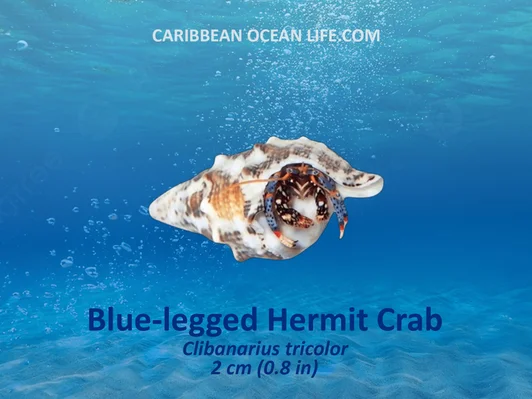
Blue Legged Hermit Crab
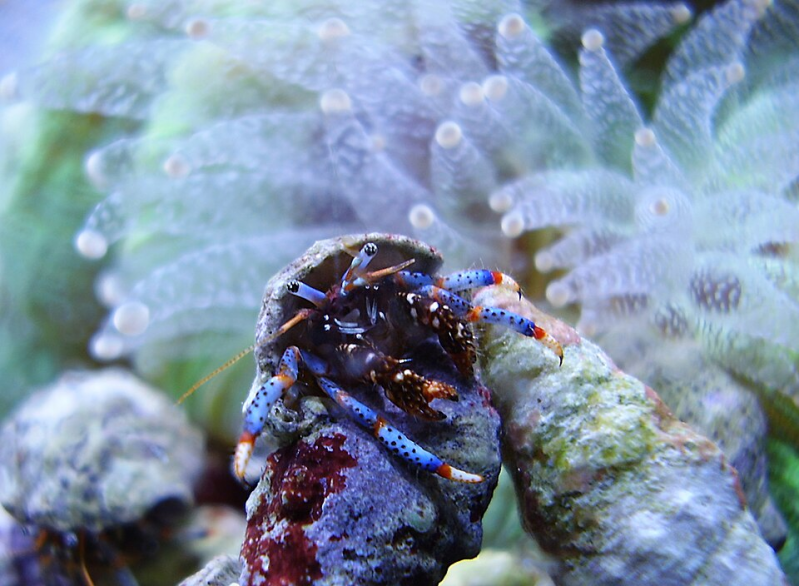
Blue Legged Hermit Crab at a Glance
👀 How common: Common in shallow Caribbean waters, although its tiny size makes it easy to overlook
🔬 Scientific name: Clibanarius tricolor
📏 Size: Small, usually around 2–3 cm (0.8–1.2 in), excluding the shell
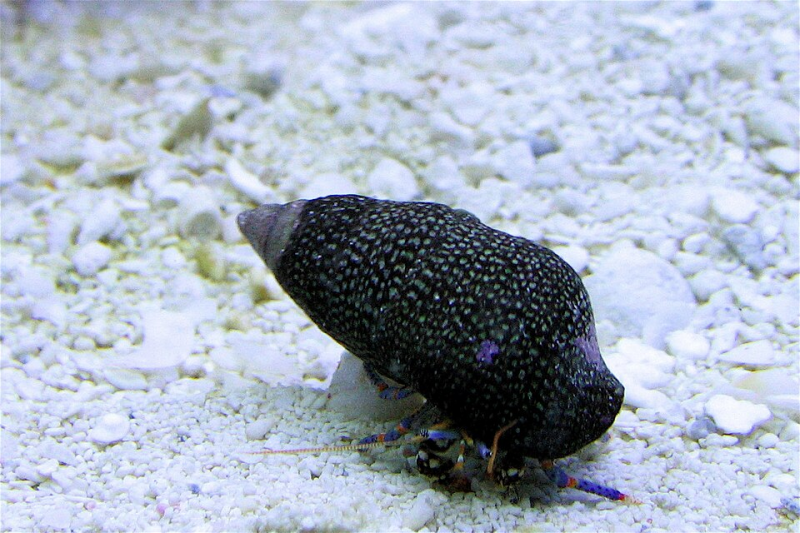
🎨 Appearance: Easily recognized by its striking blue legs with dark bands and contrasting orange or reddish markings
🌊 Habitat: Shallow reefs, rocky shores, tide pools, seagrass beds and areas with coral rubble
🍴 Diet: Omnivorous scavenger and grazer, feeding mainly on algae, detritus and other organic material
☀️ Activity: Active both day and night, moving over rocks and the seafloor in search of food
🐚 Special feature: Protects its soft abdomen inside an empty snail shell and changes shells as it grows
🔍 Shell choice: Carefully investigates potential new shells before deciding whether to move in
🌿 Algae grazer: Picks algae from rocks and other surfaces, helping clean the shallow reef environment
🛡️ Defense: Retreats completely into its shell when threatened, using its claws and legs to help block the entrance
🥚 Reproduction: Females carry eggs beneath the abdomen before releasing the larvae into the sea
♻️ Ecological role: Helps recycle organic material and grazes on algae
🏝️ Curaçao, Bonaire & Aruba: Found in shallow coastal waters around all three ABC islands
What Makes them Special?
Those Brilliant Blue Legs
Its vivid blue legs, decorated with dark bands and orange details, make this tiny hermit crab surprisingly colorful. Against a pale shell or sandy seabed, those legs really stand out.
A Tiny Reef Cleaner
Blue Legged Hermit Crabs spend much of their time picking algae and organic debris from rocks and other surfaces. Their constant grazing makes them part of the reef’s natural clean up crew.
Always Looking for a Better Home
Like all hermit crabs, they depend on empty snail shells for protection. As they grow, they need larger shells and may carefully inspect several possibilities before deciding that one is worth moving into.
A Very Quick House Move
Changing shells is a vulnerable moment. Once a Blue Legged Hermit Crab has chosen a new shell, it can transfer its soft abdomen from the old shell to the new one remarkably quickly.
Small but Busy
They may be tiny, but Blue Legged Hermit Crabs seem to be constantly on the move, climbing over rocks, investigating crevices and searching for food. Once you start looking for them in shallow water, you may suddenly notice them everywhere.
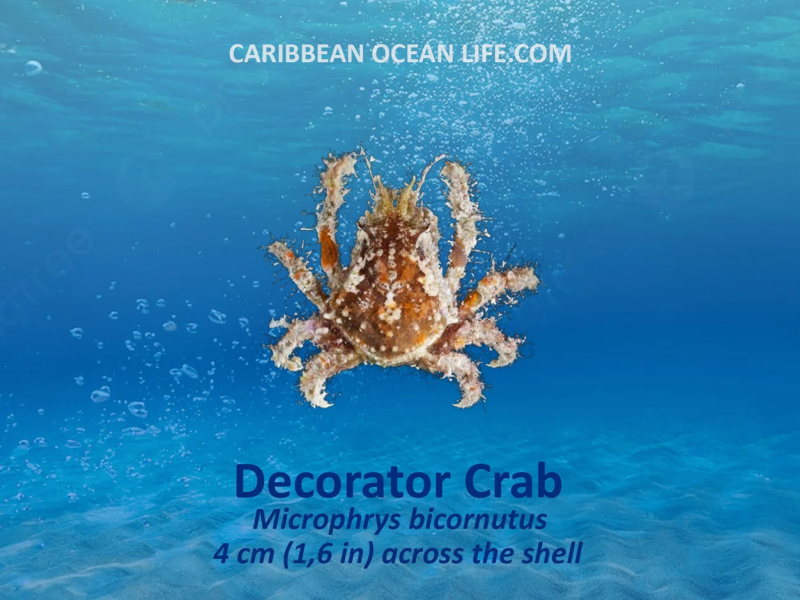
Decorator Crabs
Decorator Crabs at a Glance
👀 How common: Fairly common, but extremely easy to overlook
🔬 Family: Majoidea, a group of spider and decorator crabs
📏 Size: Usually about 2–5 cm (0.8–2 in) across the shell, depending on species
🌊 Habitat: Coral and rocky reefs, seagrass beds, algae and rubble areas
⬇️ Depth: From shallow water to deeper reefs, depending on species
🍴 Diet: Algae, small invertebrates and organic material
🐠 Behaviour: Usually solitary and slow-moving
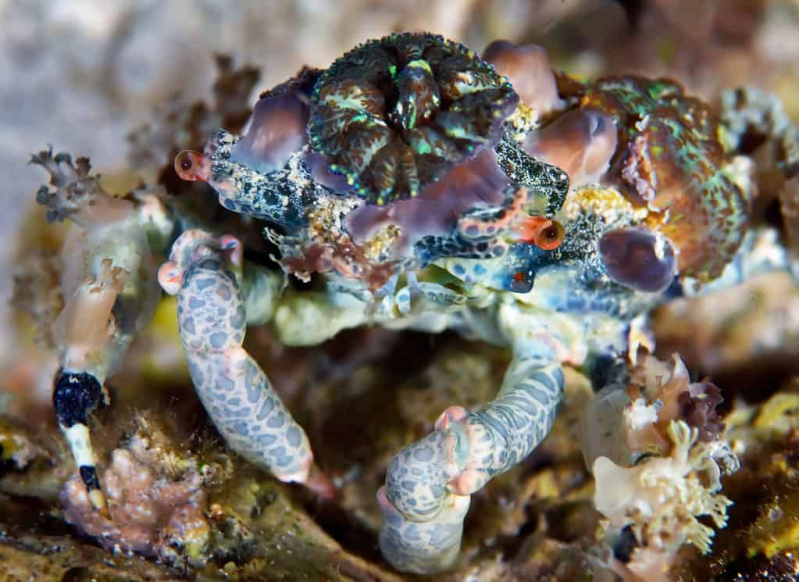
🎭 Special feature: Attach pieces of algae, sponge and other living material to their bodies for camouflage
🪝 Built for decorating: Special hooked hairs on the shell help hold the decorations in place
🎨 Camouflage: Can become so well disguised that they are almost impossible to distinguish from their surroundings
♻️ Ecological role: Small omnivores and scavengers that are part of the reef food web
🏝️ Curaçao, Bonaire & Aruba: Several species of decorator crabs occur around the ABC islands
What Makes them Special?
Dressing Up to Disappear
Decorator Crabs don't rely on colour alone for camouflage. They actively collect pieces of algae, sponge and other material from their surroundings and attach them to their bodies, creating their own living disguise.
Built-in Velcro
Their shells are covered with tiny hooked hairs that act a little like Velcro. The crab carefully hooks pieces of material onto these hairs, helping them stay firmly in place.
Choosing the Right Outfit
Decorator Crabs don't decorate themselves randomly. They often use material from their immediate surroundings, helping them blend in remarkably well with the exact place where they live.
A Disguise That Can Fight Back
Some Decorator Crabs attach organisms such as sponges or stinging hydroids to their bodies. These don't just provide camouflage, they may also make the crab less attractive to predators.
Time for a New Outfit
When a crab moults, it loses its decorated shell along with the old exoskeleton. After moulting, it has to decorate its new shell again, sometimes even reusing pieces from its old one.
Green Clinging Crab
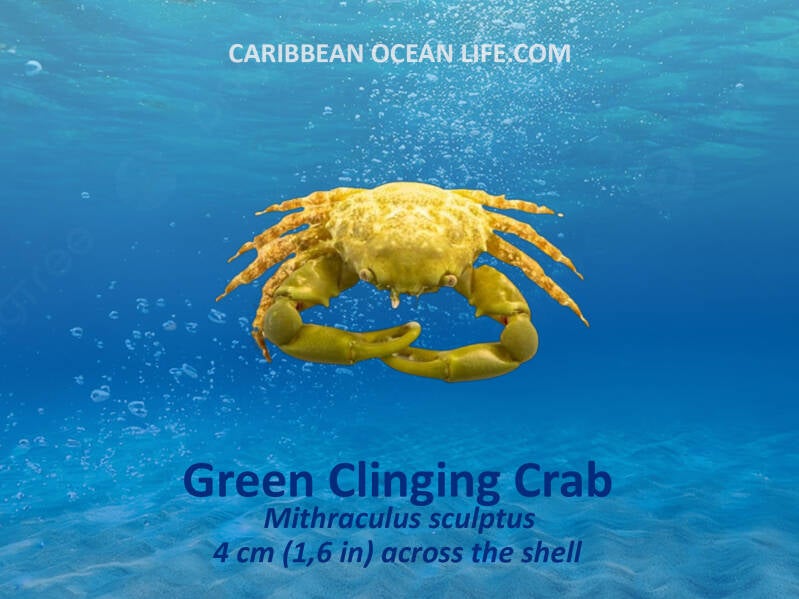
Green Clinging Crab at a Glance
👀 How common: Common on Caribbean reefs, but easily overlooked because of its excellent camouflage
🔬 Scientific name: Mithraculus sculptus
📏 Size: Small, with a carapace usually around 2–4 cm (0.8–1.6 in) wide
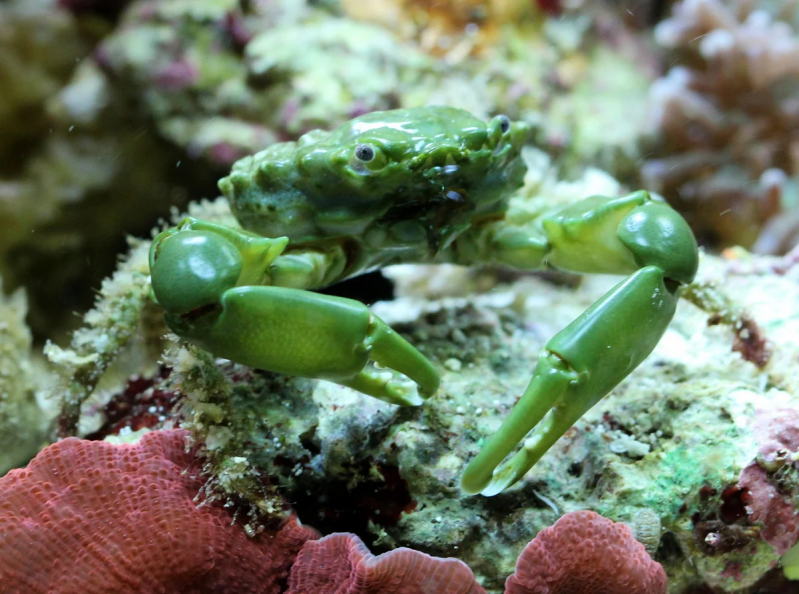
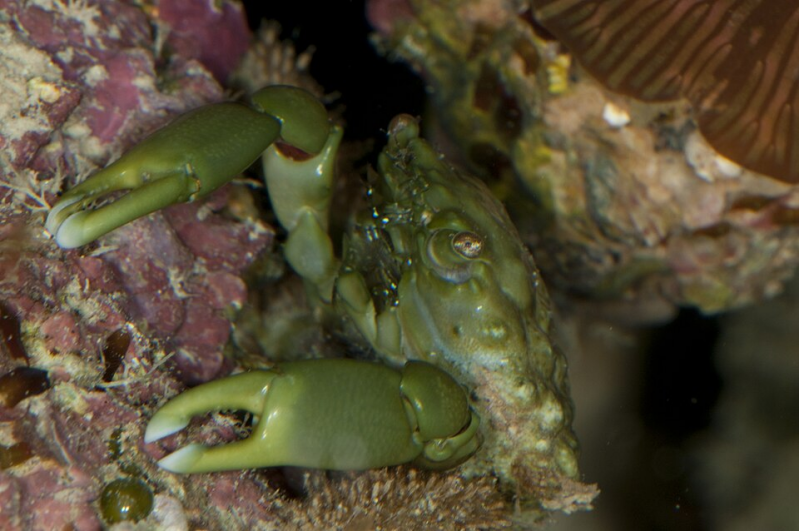
🎨 Appearance: Usually bright to dark green, often with lighter markings on the legs and claws
🪸 Habitat: Coral reefs, rocky areas, rubble and crevices, especially places with plenty of algae
🍴 Diet: Omnivorous, feeding mainly on algae and organic material, but also on small invertebrates
🌙 Activity: Often more active at night, spending much of the day hidden among rocks and coral
🦀 Special feature: Strong legs and claws allow it to cling tightly to rocks and reef surfaces, even in areas with water movement
🌿 Algae grazer: Uses its claws to scrape and pick algae from reef surfaces
🫥 Camouflage: Its green coloration helps it blend remarkably well with algae covered rocks and reef structures
🥚 Reproduction: Females carry developing eggs beneath the abdomen until the larvae are released into the water
♻️ Ecological role: Helps control algae growth and recycles organic material on the reef
🏝️ Curaçao, Bonaire & Aruba: Found in suitable reef and rocky habitats around the ABC islands
What Makes them Special?
A Tiny Algae Gardener
Green Clinging Crabs spend much of their time picking and scraping algae from rocks and reef surfaces. This makes them useful little grazers that help keep algae in check.
Excellent Camouflage
Their green coloration blends beautifully with algae covered rocks and coral. Even when one is sitting right in front of you, it can be surprisingly difficult to spot.
Built to Hold On
As the name suggests, these crabs are excellent at clinging to the reef. Their strong legs allow them to grip rocks and coral surfaces firmly, even when waves and currents are moving around them.
Small but Surprisingly Tough
Although they look delicate, Green Clinging Crabs have strong claws for their size. They use them for feeding, defending themselves and holding their ground when necessary.
A Useful Reef Resident
By grazing on algae and consuming organic material, Green Clinging Crabs contribute to the small scale clean up crew of the reef. They may be tiny, but they have their own useful role in the reef ecosystem.
Arrow crab

Photo: Pauline Walsh Jacobson
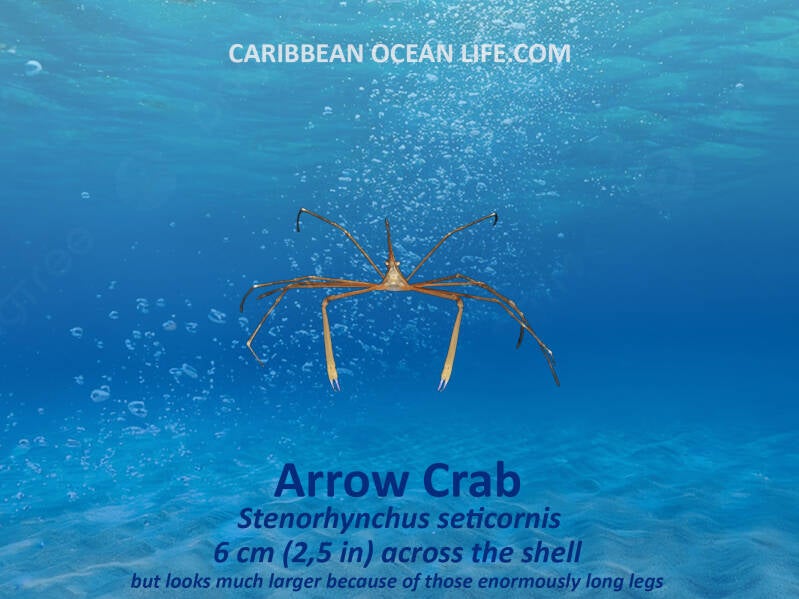
That Remarkably Long “Nose”
The most striking feature is the long, pointed rostrum extending from the front of the head. Together with the long legs, it gives the arrow crab its characteristic arrow shaped appearance.
Arrow Crab at a Glance
👀 How common: Common on Caribbean reefs, although its thin body and long legs can make it surprisingly easy to overlook
🔬 Scientific name: Stenorhynchus seticornis
📏 Size: Body about 2–3 cm (0.8–1.2 in), but much larger when its extremely long legs are included
🎨 Appearance: Small triangular body with very long, slender legs and a pointed, arrow shaped snout
🪸 Habitat: Coral reefs, rocky areas, sponges, anemones and reef crevices
🍴 Diet: Omnivorous scavenger and predator, feeding on tiny invertebrates, worms and organic remains
🌙 Activity: Often more active at night, although it can also be seen during the day
🏹 Special feature: Its extremely long legs and pointed body give it its characteristic arrow like appearance
🧹 Cleaning behavior: Sometimes picks parasites and debris from reef fish, although it is not considered a specialized cleaner
🛡️ Defense: Relies mainly on camouflage, its delicate shape and hiding among corals and other reef structures
🥚 Reproduction: Females carry their developing eggs beneath the abdomen until they are ready to hatch
♻️ Ecological role: Helps clean up organic material and preys on small reef invertebrates
🏝️ Curaçao, Bonaire & Aruba: Commonly found on reefs around all three ABC islands
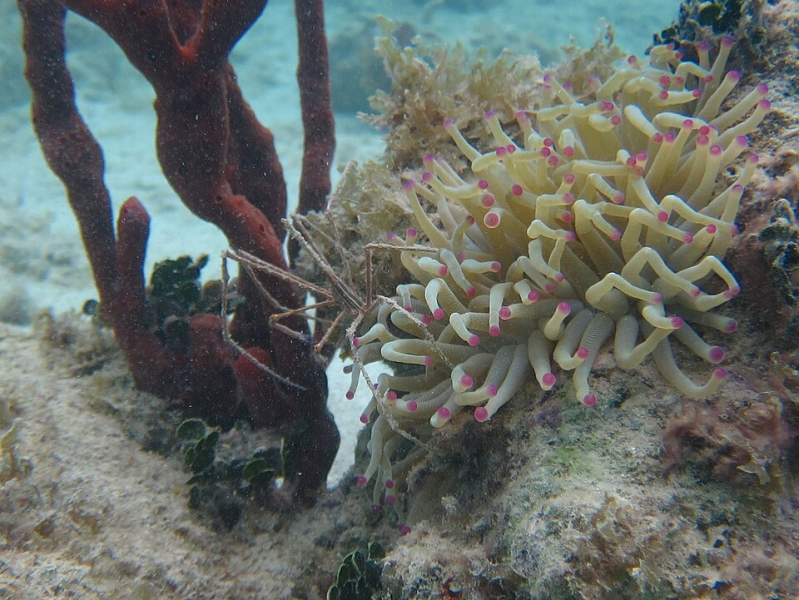
Easier to Spot Than You Might Think
Their bodies are small and well camouflaged, but those extraordinarily long legs often give them away. Look carefully beneath overhangs and around sponges, especially during a night dive, and suddenly you may notice a pair of impossibly long legs sticking out.
Their Spider Like Appearance
Arrow crabs are instantly recognizable by their extremely long, thin legs and small triangular body. Their pointed head and delicate legs make them look more like an underwater spider than a typical crab.
Masters of Reaching Into Tiny Spaces
Those long legs and slender claws are very useful for searching between rocks, corals and sponges. Arrow crabs pick small animals and bits of food from places that larger reef animals cannot easily reach.
Mostly Active at Night
During the day, arrow crabs often remain hidden beneath ledges, inside crevices or among sponges. After dark they become much more active and venture out to search for food.
Small Reef Cleaners and Hunters
Arrow crabs are opportunistic feeders. They eat detritus and scraps, but also hunt tiny worms and other small invertebrates. They are particularly known for feeding on bristle worms.
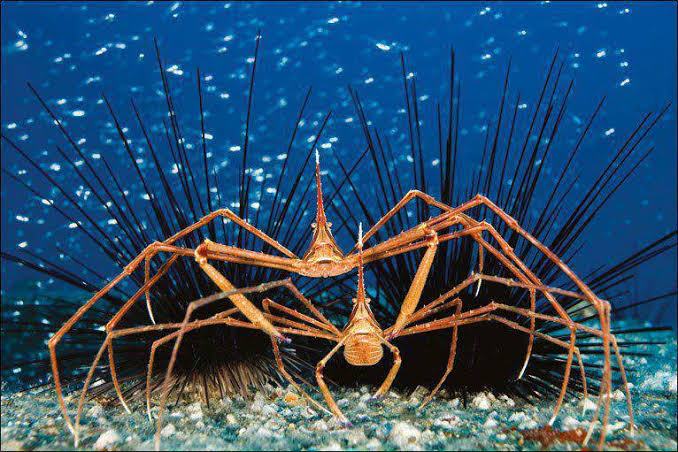
Arrow crab male and female with eggs- Photo: Jordi Chias
Females Carry Their Eggs
After mating, the female carries a mass of fertilized eggs beneath her abdomen. She keeps them there until they are ready to hatch, when tiny larvae are released into the water.
Nimble Spray Crab
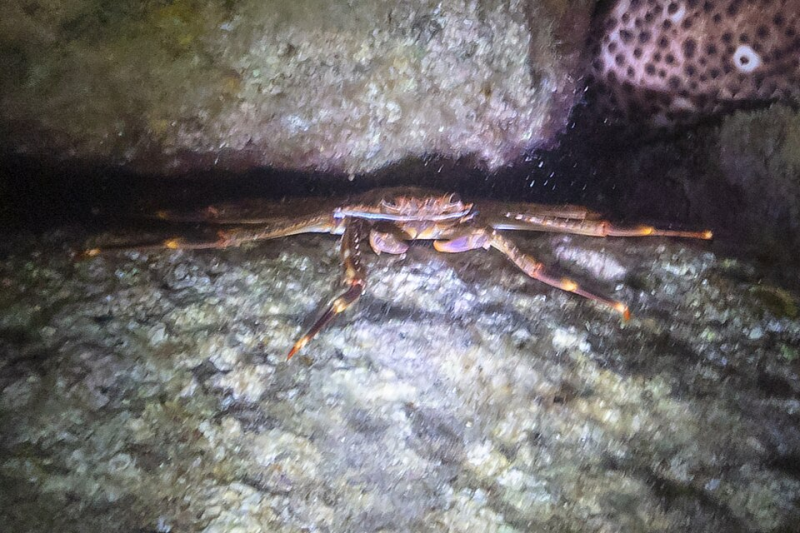
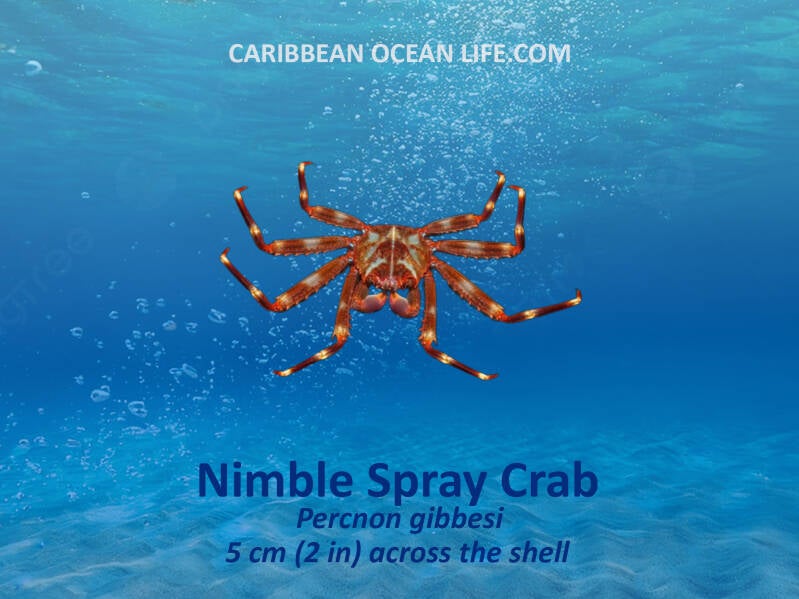
Nimble Spray Crab at a Glance
👀 How common: Common in shallow rocky coastal areas, but easily overlooked because it moves quickly and blends in well
🔬 Scientific name: Percnon gibbesi
📏 Size: Carapace up to about 3–4 cm (1.2–1.6 in) wide, with much longer legs
🎨 Appearance: Flat, dark brown to reddish body with long, slender legs marked with yellow or orange bands
🌊 Habitat: Shallow rocky shores, reef flats and wave washed rocks, often very close to the waterline
🍴 Diet: Mainly herbivorous, grazing on algae growing on rocks, but may also eat small pieces of organic material
☀️ Activity: Active during the day and often seen darting rapidly across rocks
🦀 Special feature: Extremely fast and agile, its flattened body allows it to squeeze into very narrow cracks
🌊 Life in the surf: Well adapted to areas with strong wave action, using its long legs to grip rocky surfaces
🫥 Defense: Relies on speed, camouflage and its ability to disappear quickly into narrow crevices
♻️ Ecological role: Grazes on algae and helps recycle organic material in shallow coastal habitats
🏝️ Curaçao, Bonaire & Aruba: Found along suitable rocky shores and shallow coastal habitats around the ABC islands
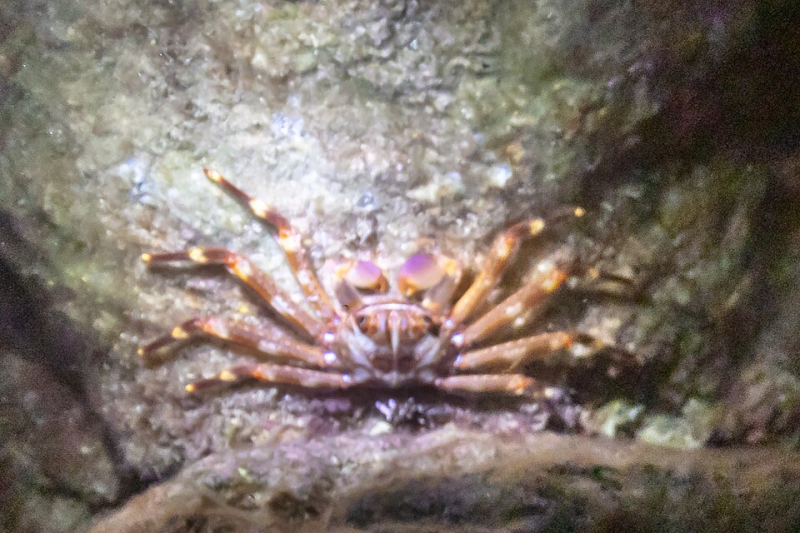
What Makes them Special?
Incredibly Fast
The name “nimble” suits this crab perfectly. It can race sideways across rocks at remarkable speed and disappear into a narrow crevice in seconds. Speed is one of its most important defenses against predators.
Built for Life in the Surf
Its flat body and long, strong legs are perfectly suited to wave washed rocky shores. It can cling tightly to the rocks while waves rush over it, then quickly move to another spot to feed.
A Busy Algae Grazer
The Nimble Spray Crab spends much of its time grazing on tiny algae growing on rocks. In doing so, it helps keep rocky surfaces clean and plays a small but useful role in the coastal ecosystem.
A Successful Traveler
Although native to tropical and subtropical parts of the Atlantic, including the Caribbean, the Nimble Spray Crab has also established itself in the Mediterranean Sea. It has spread remarkably successfully along Mediterranean rocky coastlines.
Harder to Catch Than It Looks
Those long, almost spider like legs may make it look a little creepy, but they give the crab excellent agility. Combined with its flattened body, they allow it to squeeze into cracks where larger predators simply cannot follow.
COASTAL CRUSTACEANS
FIDDLER CRAB
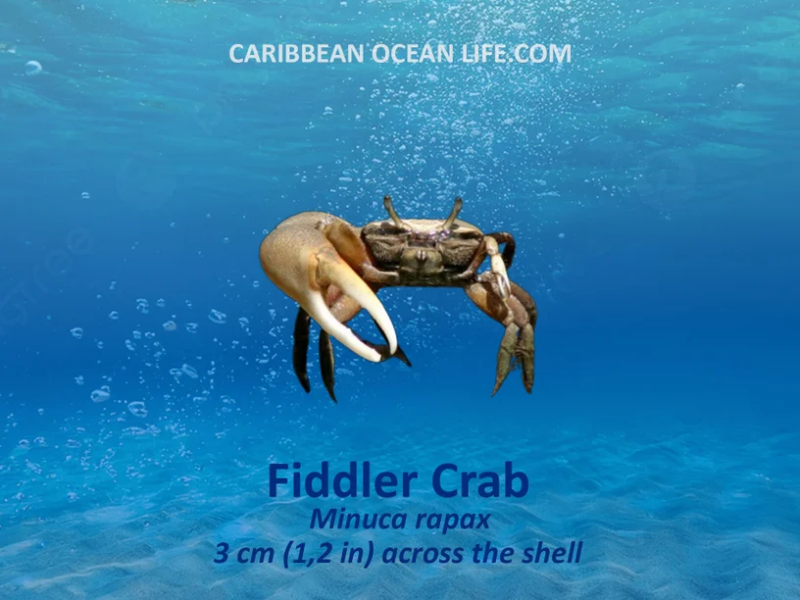
Fiddler Crab at a Glance
👀 How common: Common in suitable coastal habitats
🔬 Scientific name: Minuca rapax
📏 Size: Usually about 2–3 cm (0.8–1.2 in) across the shell
🏝️ Habitat: Muddy and sandy shores, especially around mangroves and sheltered coastal areas
🕳️ Home: Lives in burrows dug into soft sediment
🍴 Diet: Algae, organic material and tiny food particles filtered from the sediment
☀️ Activity: Mainly active during the day and around low tide
🦀 Behaviour: Often lives in large colonies
👋 Special feature: Males have one enormously enlarged claw, while females have two small claws
💕 Courtship: Males wave their large claw to attract females
⚔️ Rivalry: The large claw is also used in displays and contests between males
🌊 Coastal life: Retreats into its burrow when threatened or when conditions become unsuitable
🏝️ Curaçao, Bonaire & Aruba: Found in suitable coastal habitats around the ABC islands
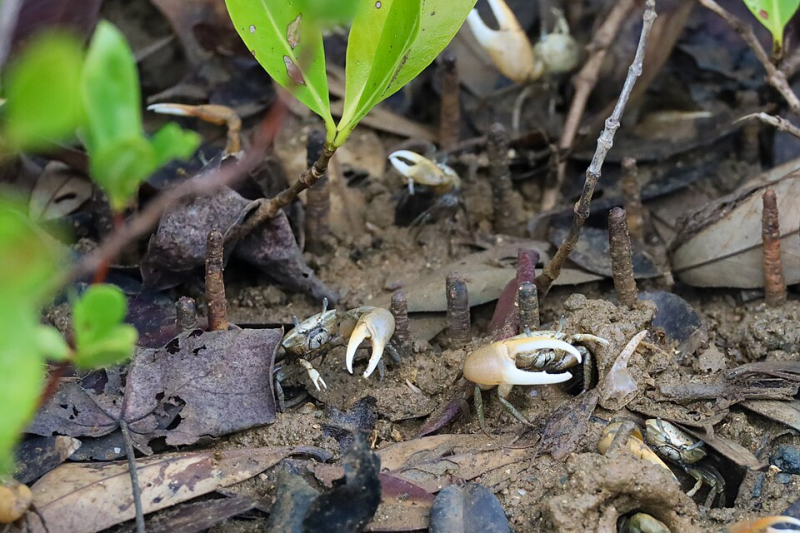
What Makes Fiddler Crabs Special?
Male or Female?
Male Fiddler Crabs have one enormous claw and one small claw. The large claw is used to attract females and to compete with other males, while the small claw is used for feeding.
Females have two small claws of roughly equal size, which means they can use both claws to feed.
Male Fiddler Crabs are impossible to miss. One claw grows enormously large, while the other remains tiny. The small claw is used for feeding, while the giant claw has a completely different purpose.
Waving to the Ladies
Males wave their oversized claw in distinctive patterns to attract females. A good wave can advertise both their presence and their quality as a potential mate.
Claw Against Claw
That giant claw is also a weapon, although fights are often more about showing off than causing damage. Males use it in contests over territory and burrows.
Eating One Handful at a Time
Fiddler Crabs scoop up sediment with their small feeding claw and separate tiny pieces of algae and organic matter from the sand or mud. The cleaned sediment is then discarded in small pellets.
Life by the Tides
Their daily routine is closely connected to the tides. When the water retreats, they emerge to feed and socialize. As conditions change, they retreat into their burrows, which also protect them from heat and predators.
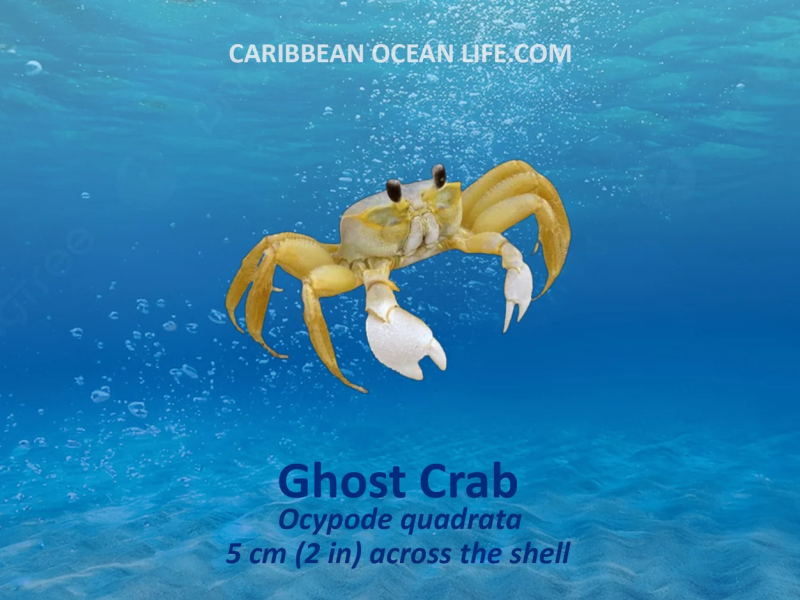
ATLANTIC GHOST CRAB
Atlantic Ghost Crab at a Glance
👀 How common: Common on suitable sandy beaches
🔬 Scientific name: Ocypode quadrata
📏 Size: Usually about 3–5 cm (1.2–2 in) across the shell
🏖️ Habitat: Sandy beaches above and around the high-tide line
🕳️ Home: Digs deep burrows in the sand for shelter from heat and predators
🍴 Diet: Small animals, carrion and organic material found along the beach
🌙 Activity: Most active from dusk through the night
🦀 Behaviour: Usually solitary and extremely alert
🏃 Special feature: An exceptionally fast runner that can disappear into its burrow in seconds
👀 Eyes: Large eyes on stalks provide a wide field of vision
🎨 Camouflage: Its pale sandy colour helps it blend into the beach
🌊 Coastal life: Lives mainly on land but depends on the marine environment and regularly returns to the water to keep its gills moist
🏝️ Curaçao, Bonaire & Aruba: Found on sandy beaches around the ABC islands
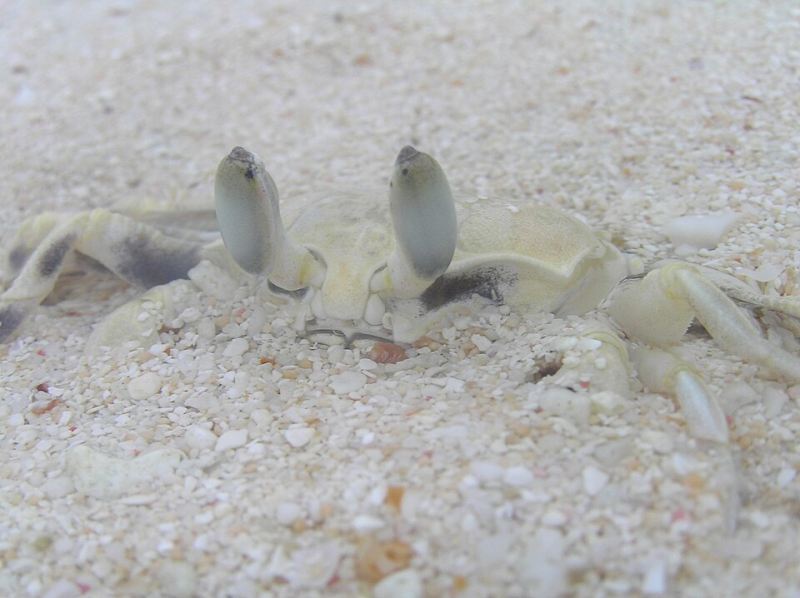
What Makes Ghost Crabs Special?
Eyes on Stalks
Their large eyes sit high on movable stalks, giving them an excellent view of their surroundings. This helps them detect predators, prey and movement across the beach.
Underground During the Day
Ghost Crabs dig deep burrows in the sand where they escape the heat and hide from predators. Fresh piles of sand around a round hole are often the first sign that one lives there.
Hunters After Dark
As the beach cools after sunset, Ghost Crabs become much more active. They are opportunistic feeders, eating small animals, carrion and other food they find along the shoreline.
Important Beach Cleaners
By feeding on dead animals and organic material, Ghost Crabs help recycle nutrients and clean up the beach. Their burrowing also mixes and aerates the sand.
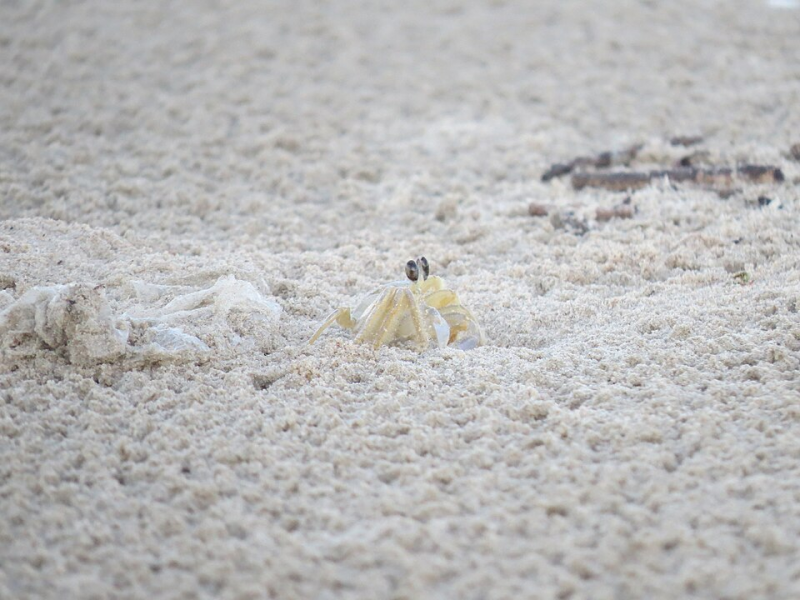
Built for Speed
Ghost Crabs are among the fastest crabs on land. Their long, powerful legs allow them to race across the sand and disappear into their burrows within seconds.
Why Are They Called Ghost Crabs?
Their pale, sandy colour makes them surprisingly difficult to spot. Combined with their speed and mainly nocturnal lifestyle, they can seem to appear and disappear like ghosts.