

TUNA

Tuna at a Glance
👀 How common: Common in deeper offshore waters around the Caribbean, but rarely seen by ordinary snorkelers close to shore
🔬 Family: Scombridae, the family that also includes mackerels and bonitos
📏 Size: Varies greatly by species, from smaller tuna under 1 m (3.3 ft) to large Yellowfin Tuna approaching 2 m (6.6 ft) or more
🐟 Body: Streamlined, muscular and torpedo shaped, with a powerful crescent shaped tail designed for fast, efficient swimming
🌊 Habitat: Mainly open ocean and deeper waters beyond the reef
🍴 Diet: Predatory, feeding mainly on fish, squid and crustaceans
💨 Speed: Powerful and exceptionally efficient swimmers, capable of rapid bursts of speed when hunting
🌡️ Special adaptation: Some tuna can keep parts of their bodies warmer than the surrounding seawater, helping their muscles perform efficiently
👥 Social life: Many species travel and hunt in schools, sometimes forming large groups
🫁 Breathing: Tuna rely heavily on continuous forward movement to force oxygen rich water across their gills
🌍 Travel: Highly mobile, with some species travelling enormous distances through the open ocean
♻️ Ecological role: Important open ocean predators that help regulate populations of smaller fish and squid
🏝️ Curaçao, Bonaire & Aruba: Blackfin, Yellowfin, Skipjack and Little Tunny can all occur in the waters around the ABC islands
Why are they special?
Tuna are among the most powerful and perfectly adapted swimmers in the ocean. They spend much of their lives in open water and are built almost entirely for movement.
Built for Speed
Their streamlined, torpedo shaped bodies, narrow tail base and strong crescent shaped tails allow tuna to move through the water with very little resistance. Even their small fins can fit close against the body to improve their hydrodynamic shape.
Always on the Move
Unlike most reef fish, tuna rarely remain in one place. They roam through open water in search of food, and some species can travel hundreds or even thousands of kilometres during their lives.
Fast and Powerful Hunters
Tuna mainly hunt fish, squid and crustaceans. They often hunt in groups, using their speed to chase schools of smaller fish. When tuna hunt near the surface, the normally calm sea can suddenly explode with fleeing fish and diving seabirds.
Life Beyond the Reef
Tuna are mainly open water fish. Around Curaçao, Bonaire and Aruba, they are more likely to be encountered in the deeper blue water beyond the reef than during an ordinary snorkel close to shore.

Poto: Marc Taquet
Why are they special?
The Giant of the Group
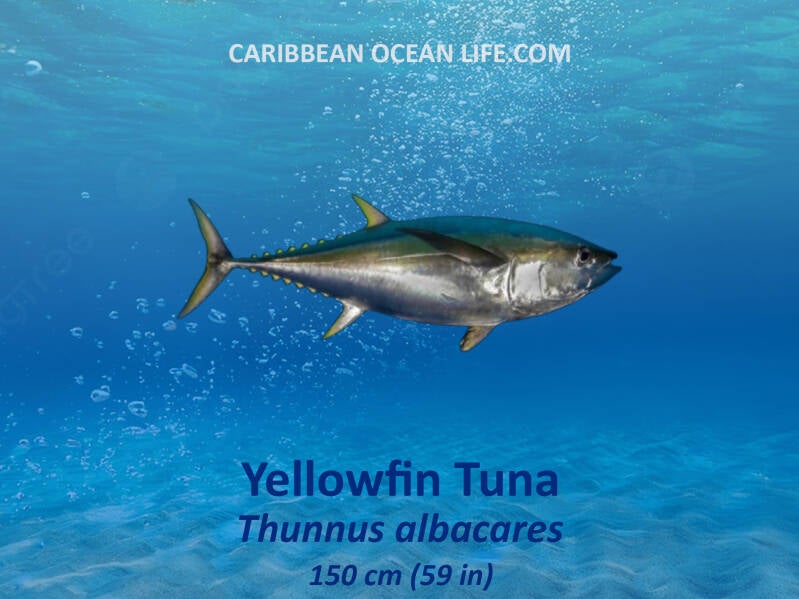
The Yellowfin Tuna (Thunnus albacares) is much larger than the other tuna species on this page. Large individuals can exceed 2 m (6.6 ft) in length and weigh well over 150 kg (330 lb), although most are considerably smaller.
Those Famous Yellow Fins
Adults are relatively easy to recognize. The second dorsal fin and anal fin are bright yellow and can become remarkably long and curved in large individuals. A series of small yellow finlets runs toward the tail.
Built for the Open Ocean
Yellowfin Tuna are true ocean travellers. They occur throughout tropical and subtropical seas around the world and can cover enormous distances in search of food and suitable water temperatures.
A Fast, Powerful Predator
Yellowfin hunt fish, squid and crustaceans. Their streamlined bodies and powerful tails allow them to accelerate rapidly when pursuing prey. They often hunt schooling fish near the surface, sometimes alongside dolphins and seabirds.
Warm Muscles, Cold Water
Like other tuna, Yellowfin have a specialized heat exchange system that allows parts of their swimming muscles to remain warmer than the surrounding water. This helps those muscles work efficiently during sustained, powerful swimming.
Rarely Standing Still
Yellowfin Tuna are beautifully adapted to almost continuous movement. They rely heavily on swimming forward to push oxygen rich water over their gills, one of the reasons a healthy tuna almost always seems to be going somewhere.
Why are they special?
A True Atlantic Tuna
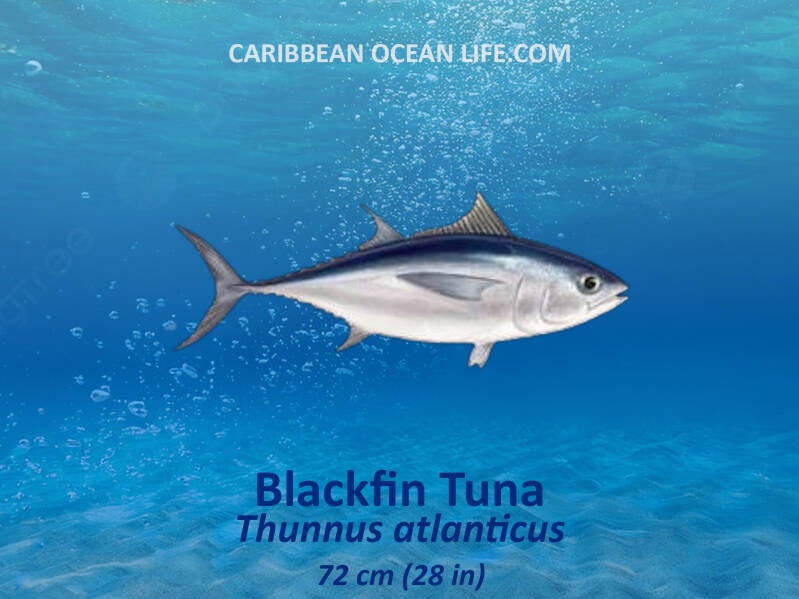
The Blackfin Tuna (Thunnus atlanticus) is found only in the western Atlantic Ocean, from the waters off the eastern United States through the Caribbean and into northern South America. This makes it a particularly characteristic tuna of the Caribbean region.
Small but Fast
Blackfin is the smallest species in the genus Thunnus. Despite its relatively modest size, it has the same streamlined body and powerful swimming ability associated with its much larger relatives.
How to Recognize It
Look for the dark back, silvery sides and especially the dark finlets near the tail. A yellowish stripe may also be visible along the side of the body.
A Social Hunter
Blackfin Tuna often travel in schools and may mix with other fast moving fish such as Skipjack Tuna. They hunt small schooling fish, squid and crustaceans in open water.
Caribbean at Heart
Of your four tuna species, this is perhaps the one I would emphasize most on Caribbean Ocean Life. Its distribution is strongly tied to the western Atlantic and Caribbean, making it much more of a Caribbean specialist than the globally distributed Yellowfin and Skipjack Tuna.
Why are they special?
The Striped Tuna
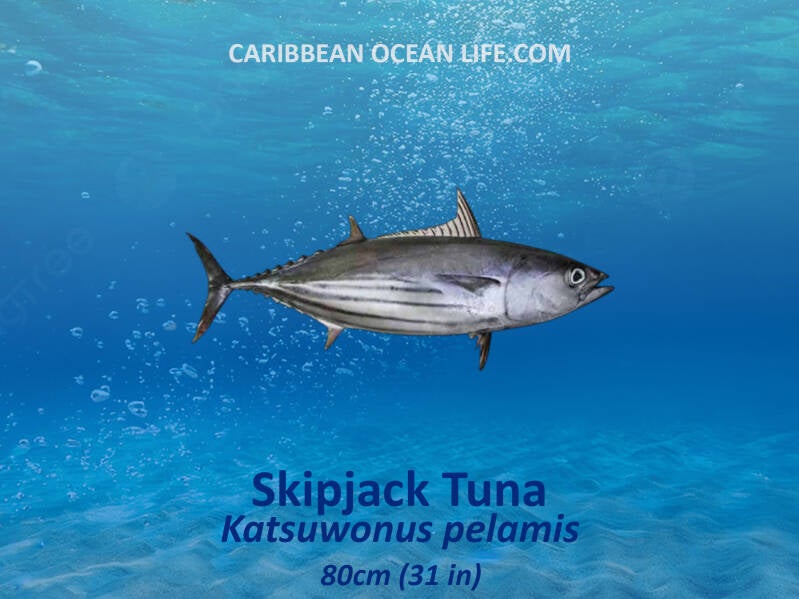
The Skipjack Tuna (Katsuwonus pelamis) is one of the easiest tuna to recognize. Its silvery belly has several distinctive dark horizontal stripes running from behind the pectoral fins towards the tail.
Small but Extremely Energetic
Skipjack are considerably smaller than Yellowfin Tuna, usually around 50–80 cm (20–31 in). What they lack in size, they make up for in speed and energy. They are powerful swimmers that spend much of their lives on the move.
Safety in Numbers
Skipjack are highly social and can form enormous schools, sometimes containing thousands of fish. They may also school together with other tuna species.
A Feeding Frenzy
Schools of Skipjack hunt small fish, squid and crustaceans. When they drive prey towards the surface, the water can become spectacularly active, with tuna attacking from below and seabirds diving from above.
A True Ocean Traveller
Skipjack occur throughout tropical and warm temperate oceans around the world. They are highly mobile and may travel considerable distances following prey and favorable water conditions.
The Tuna Behind Many Cans
There is a good chance that someone who has eaten canned tuna has eaten Skipjack. It is one of the world's most heavily fished tuna species and accounts for a large proportion of the global canned tuna market.
Why are they special?
Small in Name, Not Necessarily in Size
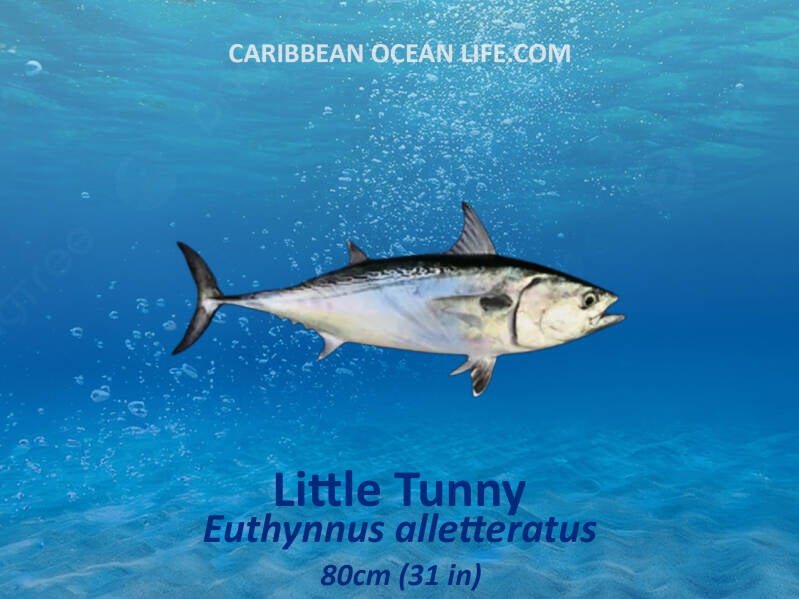
The Little Tunny (Euthynnus alletteratus) is one of the smaller tuna relatives, but it can still grow to more than 1 m (3.3 ft) long. Most individuals are considerably smaller.
Easy to Recognize
One of its best identification features is the pattern of dark, wavy lines on the upper back, behind the first dorsal fin. It also usually has several dark spots between the pectoral and pelvic fins.
A Coastal Tuna
Unlike many tuna that spend most of their lives far offshore, Little Tunny are often found relatively close to the coast. They occur around islands, reefs and other areas where schools of small fish gather.
A Fast Schooling Hunter
Little Tunny often hunt in groups, chasing small schooling fish such as sardines and anchovies. When feeding near the surface, they can create spectacular bursts of activity as prey fish scatter in every direction.
Tuna, but Not Thunnus
Despite its tuna like appearance, the Little Tunny belongs to the genus Euthynnus, rather than Thunnus, the genus containing Blackfin and Yellowfin Tuna. It is closely related to other tunas and mackerels within the family Scombridae.
Often Confused with Other Tuna
At first glance it can resemble a small Blackfin or Skipjack Tuna. The combination of wavy markings on the back and dark spots below the pectoral fin is the best clue that you are looking at a Little Tunny.