

EELS
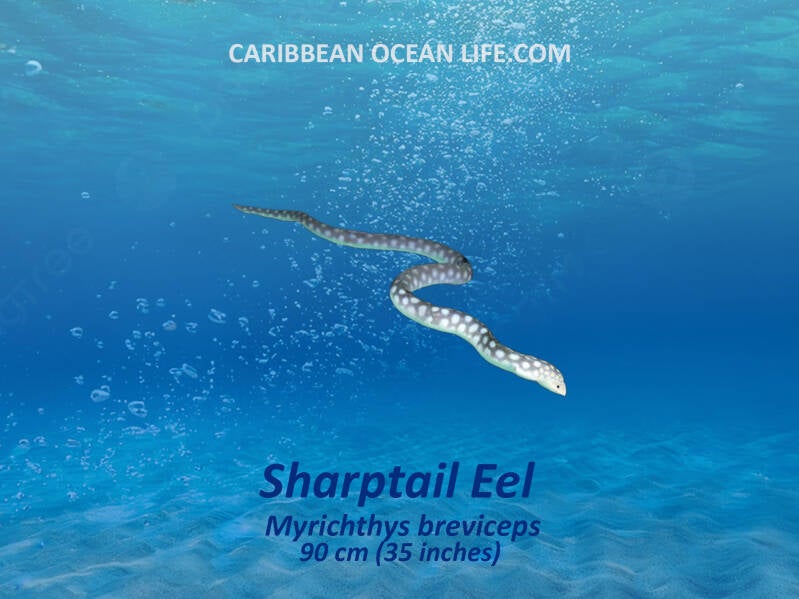

Eels of the Caribbean
Eels come in many shapes and lifestyles. Some hide between rocks and coral, others disappear beneath the sand, while Garden Eels spend most of their lives inside a burrow with only their upper body sticking out.
Around Curaçao, Bonaire and Aruba you can encounter several different groups, including Moray Eels, Snake Eels and Garden Eels. Despite their snake-like appearance, they are all true fish, complete with gills and fins.
MORAY EEL

Moray Eels at a Glance
👀 How common: Common to fairly common
🔬 Family: Muraenidae
📏 Size: About 20–200 cm (8–79 in), depending on species
🌊 Habitat: Coral reefs, rocky areas, caves and crevices
⬇️ Depth: From shallow reefs to over 100 m (330 ft), depending on species
🐟 Diet: Fish, crabs, shrimp, octopuses and other marine animals
🌙 Activity: Many species are most active at night
🐠 Behaviour: Usually solitary, spending much of the day hidden inside the reef
👄 Special feature: A second set of jaws in the throat helps pull prey into the mouth
😬 Appearance: They repeatedly open and close their mouths to pump water over their gills, not because they are threatening you
🥚 Reproduction: Eggs and larvae develop in open water before young morays settle on the reef
♻️ Ecological role: Important reef predators that help keep prey populations in balance
🏝️ Curaçao, Bonaire & Aruba: Several species occur around all three islands, including Green, Spotted, Goldentail and Chain Moray Eels

Green Moray eel
Most Common Moray Eels Aruba, Bonaire and Curaçao
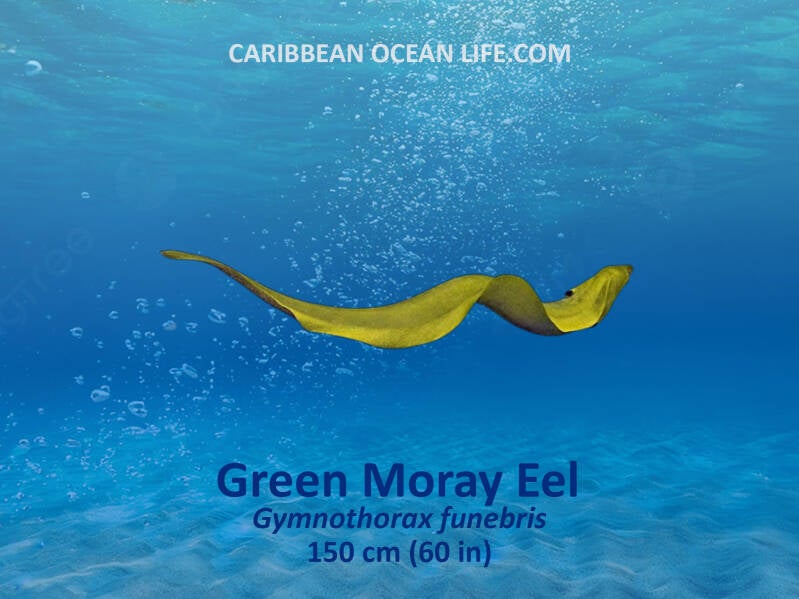
Green Moray Eel (Gymnothorax funebris) – The largest and most impressive moray eel in the region. Its bright green color is actually caused by a layer of yellowish mucus covering its blue skin.
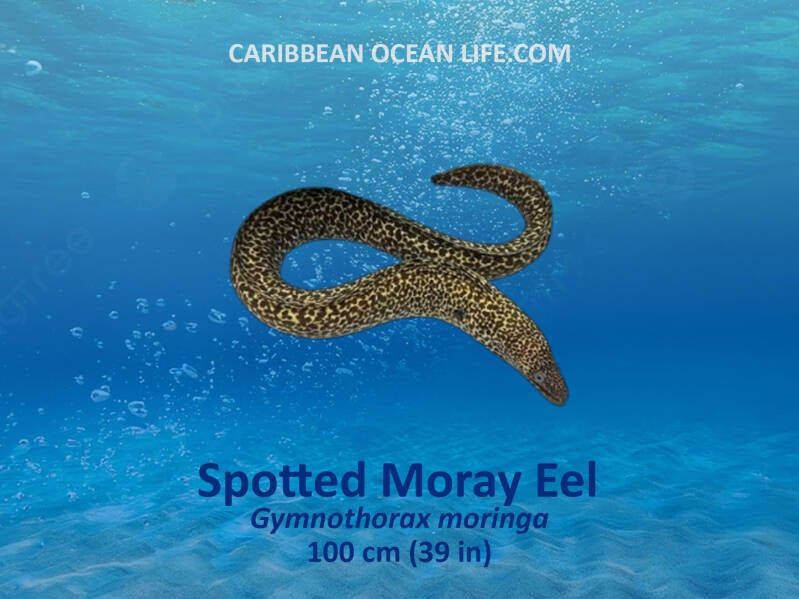
Spotted Moray Eel (Gymnothorax moringa) – A very common moray, usually white to pale yellow and covered from head to tail with numerous small dark brown to black spots.
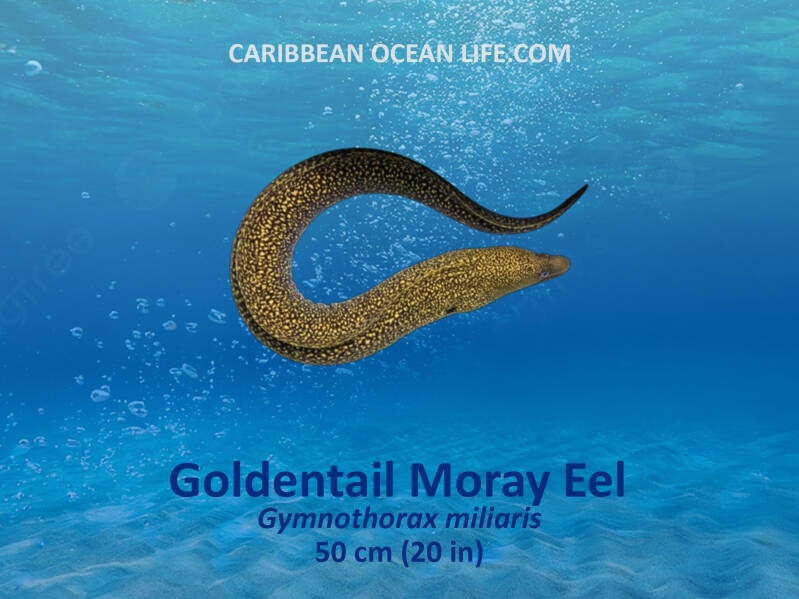
Goldentail Moray Eel (Gymnothorax miliaris) – A smaller species, usually dark brown or purplish, covered with hundreds of tiny golden spots and distinguished by its striking yellow-tipped tail.
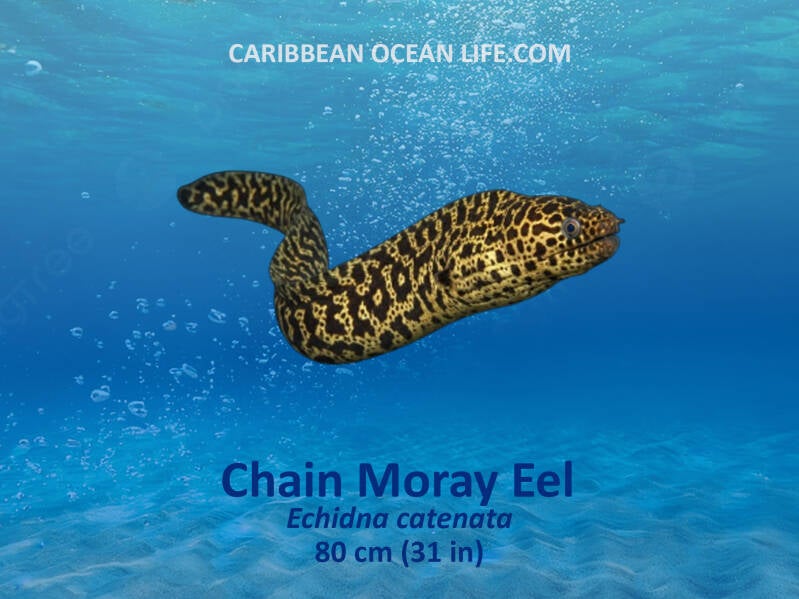
Chain Moray Eel (Echidna catenata) – Easily recognized by its distinctive yellowish chain-like pattern against a dark background. This species is often found in relatively shallow water.
What makes them special

Built for Life Between the Rocks
Their long, flexible bodies allow morays to disappear deep into narrow cracks and crevices where many other predators cannot go. During the day, you may see little more than a head sticking out of the reef.
A Second Set of Jaws
Morays have one of the strangest feeding mechanisms in the fish world. Hidden inside their throat is a second set of jaws, called pharyngeal jaws. When a moray grabs prey, these jaws can move forward, seize it and pull it deeper into the throat.
Hunters After Dark
Many Moray Eels become more active after sunset. Under the cover of darkness, they leave their hiding places to search the reef for fish, crabs, shrimp and octopuses.
Fierce Looking, but Usually Shy
Despite their fearsome teeth, Moray Eels generally prefer to avoid people rather than attack them. Give them space, never try to touch or feed them, and they are fascinating animals to watch.

Why Are They Always Opening Their Mouth?
A Moray Eel with its mouth wide open can look rather threatening, but it usually isn't trying to scare you. Morays repeatedly open and close their mouths to pump water over their gills, helping them breathe while resting inside the reef.
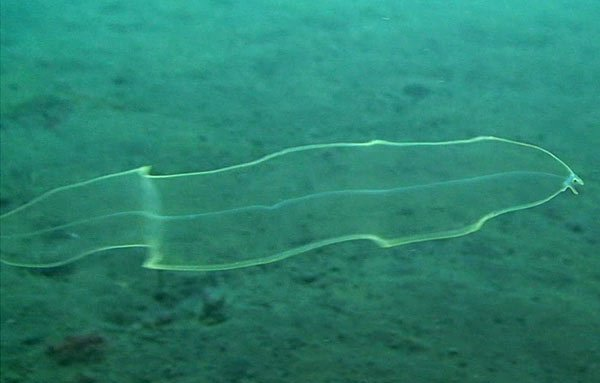
From Tiny Drifters to Reef Hunters
Moray Eels begin life looking nothing like the adults. After hatching, the young develop into tiny, transparent, ribbon-like larvae called leptocephali. Instead of living on the reef, these delicate larvae drift with ocean currents in the open sea, sometimes for months.
Eventually, they undergo a remarkable transformation. Their transparent, leaf-like bodies change into the long, snake-like shape of a young moray, which then settles on the reef and begins life as a hidden reef predator.
GARDEN EELS
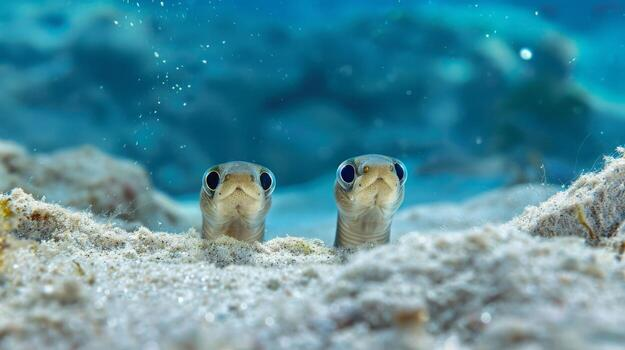
Garden Eels at a Glance
👀 How common: Fairly common in suitable habitats
🔬 Family: Congridae
📏 Size: Garden Eels up to about 50 cm (20 in), Conger Eels can grow to over 1 m (39 in)
🌊 Habitat: Sandy bottoms for Garden Eels, reefs, rocks and crevices for Conger Eels
⬇️ Depth: From shallow water to over 100 m (330 ft), depending on species
🍤 Diet: Zooplankton for Garden Eels, fish and crustaceans for Conger Eels
🐠 Behaviour: Garden Eels live in colonies, Conger Eels are generally more solitary
🏠 Special feature: Garden Eels spend most of their lives in burrows, extending part of their body above the sand
😳 Shy: Garden Eels quickly disappear backwards into their burrows when approached
🏝️ Curaçao, Bonaire & Aruba: Brown Garden Eels are found around the ABC islands
Why are they special?

Now You See Them, Now You Don't
Garden Eels are extremely shy. As a diver approaches, they slowly disappear backwards into their burrows, often one after another. Move away again and, little by little, the whole garden begins to reappear.
Dinner Comes to Them
Instead of searching for food, Garden Eels simply face into the current and wait. They sway above their burrows and pick tiny zooplankton drifting past in the water.

An Underwater Garden
Garden Eels live in colonies on sandy bottoms. Each eel stays in its own burrow, extending part of its long body into the water. When dozens or even hundreds appear together, they look remarkably like plants growing from the seabed, which explains the name Garden Eel.
SHARP TAIL EEL
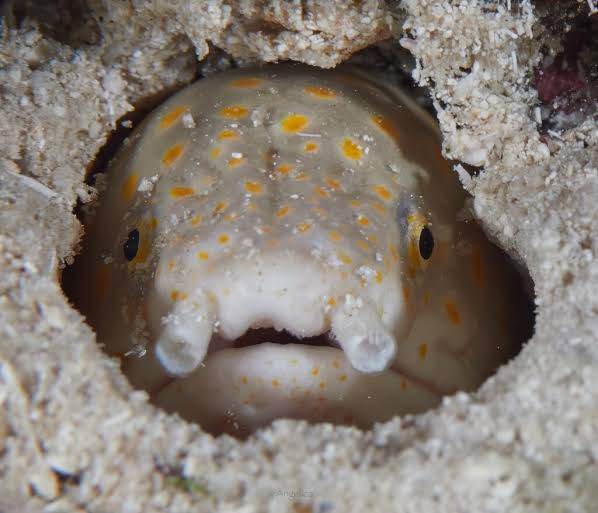
Sharptail Eel at a Glance
👀 How common: Fairly common, but often overlooked
🔬 Scientific name: Myrichthys breviceps
🐍 Family: Ophichthidae, Snake Eels
📏 Size: Usually 40–70 cm (16–28 in), up to about 100 cm (39 in)
🌊 Habitat: Sandy bottoms, seagrass beds and sandy areas around reefs
⬇️ Depth: Shallow water to about 30 m (100 ft)
🦐 Diet: Small crustaceans and other animals hidden in the sand
🐠 Behaviour: Usually solitary, often moving along or partly beneath the sand
⛏️ Special feature: Its pointed tail helps it burrow into soft sediment
🎨 Colour: Pale body covered with distinctive dark spots
🐍 Appearance: Its long, slender body makes it look remarkably snake-like
🏝️ Curaçao, Bonaire & Aruba: Found around all three ABC islands

What Makes the them Special?
Built for Burrowing
The Sharptail Eel is perfectly adapted to life around sandy bottoms. Its long, slender body and pointed tail allow it to burrow into the sand, where it can hide from predators and search for small animals.
Disappearing
When disturbed, a Sharptail Eel can quickly disappear into the seabed. It may also move beneath the surface of the sand, making it seem as though the eel has simply vanished.
A Snake That Isn't a Snake
With its long body, small head and spotted pattern, the Sharptail Eel looks remarkably snake-like. But despite its appearance, it is of course a true fish, breathing through gills and equipped with fins.
Following Its Nose
Sharptail Eels use their excellent sense of smell to help locate small crustaceans and other prey hidden in the seabed. You may see one slowly exploring the sand with its head close to the bottom, searching for its next meal.